

AI Operations Support Services: A Pragmatic Guide to Scaling Tech Teams in 2026
As Artificial Intelligence moves from experimental labs to core business operations, the primary challenge is no longer just building a model—it's maintaining it. The success of any AI system depends on a constant stream of high-quality data and human oversight, creating a significant operational workload. For tech leaders in Singapore, scaling the human teams required to manage this workload presents a critical bottleneck, caught between the high cost of local talent and the complexities of managing offshore freelancers.
This guide offers a pragmatic solution: managed remote AI operations support services. Discover how a dedicated, same-timezone team extension can solve the human operational bottleneck in AI deployment, allowing your core engineering team to focus on innovation while ensuring your AI models perform reliably and accurately.
What are AI Operations Support Services in 2026?
In the context of scaling modern tech teams, AI Operations Support Services refer to the managed human talent and infrastructure required to maintain the lifecycle of AI models. This is fundamentally different from AIOps, which is software designed to automate IT infrastructure management using machine learning. While AIOps focuses on machines monitoring machines, AI Operations Support is about people managing the quality, safety, and accuracy of your AI systems.
By 2026, the industry's focus has decisively shifted from theoretical AI development to practical, operational AI deployment. This transition highlights a critical truth: AI is not self-sufficient. It requires a dedicated human backbone for tasks that demand nuance, context, and consistent judgment. This is where managed talent services become essential, providing the operational personnel needed to handle data processing, model monitoring, and human-in-the-loop validation.
- A Clear Definition: AI Operations Support consists of the human-led processes and teams responsible for data preparation, model validation, and ongoing performance monitoring for AI systems.
- The AIOps Distinction: Unlike AIOps software that automates IT tasks, AI Operations Support provides the essential personnel—such as Data Annotators, AI Response Evaluators, and QA Engineers—that AI models rely on for training and fine-tuning.
- The 2026 Operational Shift: The era of AI as a standalone experiment is over. Businesses now require robust operational frameworks to ensure their AI investments deliver consistent value and operate safely in production environments.
- The Role of Managed Talent: Managed services provide a stable, scalable workforce to maintain model accuracy, prevent data drift, and perform the critical human feedback tasks that even the most advanced algorithms cannot automate.
The Shift from Model Building to Model Maintenance
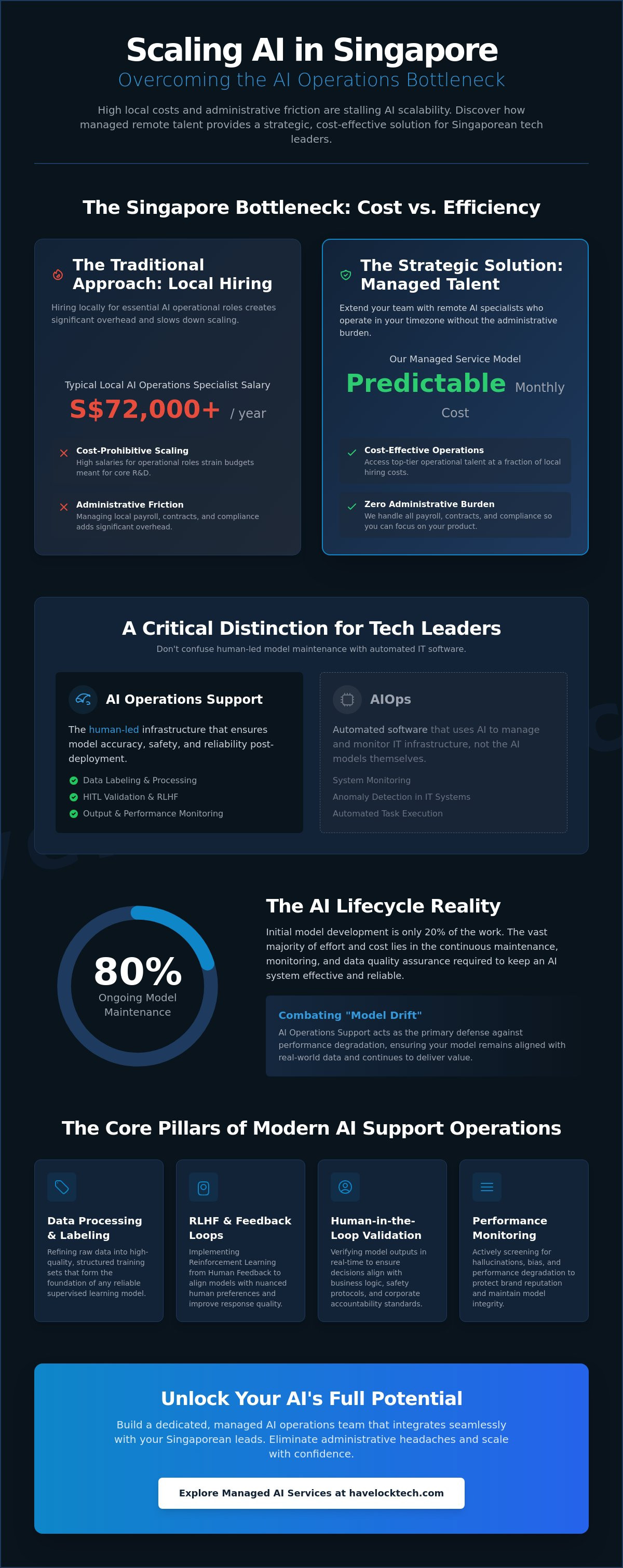
Building an AI model is often just the initial phase, representing a fraction of the total effort. The vast majority of the work lies in the ongoing maintenance, monitoring, and retraining required to keep the model effective in a changing world. Production AI systems require a constant supply of fresh, accurately labeled data to prevent "model drift," a phenomenon where performance degrades as real-world data evolves away from the original training set. AI operations support services provide the continuous human oversight needed to manage these data pipelines and ensure the model remains aligned with business objectives.
Key Functional Areas of AI Support Personnel
The work performed by AI support teams is foundational to the success of any machine learning project. These are not high-level strategic roles but essential, execution-focused functions that form the bedrock of AI reliability. Key areas include:
- Data Processing and Clean-up: Preparing and structuring vast datasets for model training, ensuring consistency and removing inaccuracies. This work is typically performed by roles like Data Collection Assistants and Data Labelers.
- Human-in-the-Loop (HITL) Validation: Acting as the human checkpoint for AI-driven decisions, where personnel verify outputs, correct errors, and handle edge cases that algorithms cannot confidently resolve.
- Managed Monitoring of AI Output: Systematically reviewing AI-generated content and responses to identify issues like hallucination, bias, or factual inaccuracies, a core task for AI Response Evaluators and Prompt Testers.
The Core Pillars of Modern AI Support Operations
Effective AI operations are built on a foundation of meticulously executed human tasks. These pillars ensure that the data fed into your models is of the highest quality and that the models themselves behave as intended. A managed support team provides the structure and consistency required to execute these functions at scale.
- Data Annotation and Labeling: The fundamental process of tagging data to make it understandable for machine learning algorithms. This is the cornerstone of supervised learning and requires high accuracy and consistency.
- Reinforcement Learning from Human Feedback (RLHF): A critical technique for fine-tuning generative AI and large language models. It involves human operators ranking and evaluating AI responses to guide the model toward more helpful, harmless, and accurate behavior.
- Model Validation and Testing: A systematic process where QA Engineers and App Support Specialists test the AI model against predefined benchmarks and real-world scenarios to ensure it is reliable, fair, and ready for production.
- Operational Monitoring: The ongoing tracking of a live AI model's performance against key business metrics. This includes monitoring for accuracy, latency, and unintended behavior, ensuring the AI continues to deliver its expected value.
High-Volume Data Processing and Labeling
As AI systems become more sophisticated, so do their data requirements. The need has moved beyond simple image tagging to encompass complex tasks like semantic segmentation in images, sentiment analysis in text, and entity recognition in documents. This work often requires domain-specific understanding to ensure labels are contextually correct. A managed AI support team, staffed with trained Data Annotators and Labelers, can manage these high-volume data pipelines efficiently, delivering the quality and consistency needed without distracting your core engineering team.
RLHF and Model Fine-Tuning
For generative AI applications, RLHF is non-negotiable for ensuring safety and usefulness. This process relies on a team of dedicated AI Response Evaluators to systematically grade and rank model outputs. The consistency of this human feedback is paramount; conflicting or low-quality feedback can prevent a model from converging on the desired behavior. A managed service model excels here by establishing clear guidelines, providing consistent training, and overseeing a team of evaluators to ensure the feedback data is uniform and high-quality, directly contributing to a better-performing model.
The Singapore Bottleneck: Why Local AI Hiring is Stalling
For companies in Singapore, the ambition to scale AI initiatives often collides with a significant operational reality: building and managing a large, in-house support team is incredibly challenging. The local market presents a unique set of hurdles that can stall growth and divert resources from core product development.
The primary issue is not a lack of senior engineers, but the difficulty in rapidly scaling the essential support-level workforce needed for data operations. Hiring dozens of Data Labelers, QA Engineers, or Support Engineers locally is a slow, expensive, and administratively heavy process. This friction forces many tech leaders into a difficult choice: either slow down their AI roadmap or burn capital on an inefficient hiring model.
- The Challenge of Scaling Operational Talent: While Singapore has world-class senior talent, finding, hiring, and managing the required volume of entry-level and early-career operational staff is a significant logistical challenge.
- Cost-Prohibitive In-House Teams: Building a full-scale support team in-house carries substantial costs beyond salaries, including benefits, office space, and administrative overhead, making it financially unviable for many scaling companies.
- The Administrative Friction of HR: The process of local hiring, onboarding, payroll, and compliance for a large support team consumes significant time and resources from technical managers who should be focused on product and strategy.
- The Unreliability of Freelance Platforms: While seemingly a flexible alternative, relying on a disparate group of freelancers often fails to meet enterprise requirements for security, data privacy, and consistent quality, creating more management overhead than it solves.
The True Cost of Local Headcount
When evaluating the cost of a local hire, the salary is only the starting point. The total cost of an employee includes employer contributions, mandatory benefits, insurance, office space, equipment, and software licenses. Furthermore, the opportunity cost of long hiring cycles in the fast-moving AI sector can be immense. Delays in scaling your data processing capacity can mean a direct delay in model improvement and deployment. A managed service model converts these variable, complex costs into a predictable monthly operational expense.
The Administrative Burden of Scaling
As a support team grows, so does the administrative complexity. Managing payroll, leave, performance, and local labor compliance for a team of 10, 20, or 50 individuals is a full-time job—one that often falls on the shoulders of technical leads or operations managers. This distraction from core responsibilities is a hidden tax on productivity. Managed AI operations support services offload this entire back-office burden, handling all HR and administrative functions so you can focus solely on the work output.
Integrating Managed Remote AI Talent: A Practical Framework
Successfully integrating a remote support team is not about outsourcing a task list; it's about extending your operational capacity. A managed service model provides a structured framework for this integration, ensuring the remote team functions as a seamless part of your organization. The process is built on clear communication, secure processes, and perfect timezone alignment.
The goal is to create a "Team Extension" where the managed personnel are fully dedicated to your projects and integrated into your workflows, communication channels, and culture. This stands in stark contrast to a traditional "project-based" outsourcing model, where a vendor works in a black box with limited transparency.
- Define Clear Workflows and Quality Benchmarks: The first step is to document the exact operational processes and quality standards the team will follow. This ensures everyone is aligned on expectations from day one.
- Ensure GMT+8 Timezone Alignment: For real-time collaboration with Singapore-based teams, same-timezone operation is critical. This eliminates communication delays and enables agile feedback loops.
- Establish Secure Data Access and Compliance Protocols: Set up secure, role-based access to necessary data and systems. The managed service provider must adhere to strict data privacy standards, such as Singapore's PDPA.
- Implement a 'Team Extension' Model: Treat the remote personnel as dedicated members of your team. Integrate them into your daily stand-ups, project management tools (like Jira or Asana), and communication platforms (like Slack or Teams).
The Power of GMT+8 Synchronization
For agile AI teams, same-timezone collaboration is non-negotiable. The ability to ask a question and get an answer in minutes, rather than hours or the next day, is essential for maintaining momentum. GMT+8 alignment eliminates the "overnight lag" common with traditional offshore hubs. This synchronous communication drastically improves the quality of data processing and human feedback, as clarifications can be made instantly, reducing errors and rework. It transforms the remote team from a distant vendor into a present and active operational partner.
Security and Data Privacy in Remote Ops
Handing sensitive data to a third party requires a foundation of trust and robust security protocols. A professional managed services provider ensures this by implementing secure remote work environments for their personnel, often including endpoint security, VPNs, and strict access controls. They must be ableto demonstrate compliance with national data protection standards like the PDPA. Furthermore, a managed model provides clear audit trails and management oversight, offering a level of security and accountability that is nearly impossible to achieve with a scattered team of individual freelancers.
The Havelock Tech Advantage: Managed AI Support for Singapore
Havelock Tech was founded on a pragmatic principle: scaling a tech company's operational capacity should be straightforward and predictable. We provide dedicated, managed remote talent that integrates directly into your Singapore-based team, operating in your timezone (GMT+8) to eliminate the friction and lag of traditional offshoring.
Our model is designed specifically for tech leads and operations managers who need reliable execution without the administrative burden of hiring. We specialize in providing the essential personnel required for modern AI operations, including Data Annotators, AI Response Evaluators, QA Engineers, and App Support Specialists.
- Dedicated Remote Talent: Your managed personnel work exclusively for you, becoming a true extension of your in-house team and culture.
- Complete Managed Service: We handle all administrative complexities, including international payroll, HR, local compliance, and performance management, so you can focus on results.
- Specialized Focus on AI Ops: We understand the specific needs of AI teams, providing trained personnel for data processing, RLHF, model validation, and quality assurance.
- Pragmatic, GMT+8 Aligned Execution: We deliver the operational horsepower you need, synchronized with your workday for seamless, real-time collaboration.
Beyond Staffing: A Managed Partnership
It is crucial to understand that Havelock Tech is not a recruitment agency or a freelance marketplace. We are a managed services partner. Our role extends beyond finding talent; we provide ongoing oversight, quality assurance, and administrative support for the entire duration of our engagement. This ensures stability and performance, freeing you from the day-to-day complexities of managing a remote workforce. Our transparent, predictable monthly fees cover everything, with no hidden administrative costs, allowing for precise budget planning.
Ready to Scale Your AI Operations?
If you are struggling with the operational workload of your AI initiatives and facing the bottleneck of local hiring, a managed remote team is the most efficient path forward. The process begins with a consultation to understand your specific needs, allowing us to assemble a dedicated team of AI support personnel tailored to your project. Transition from local operational constraints to remote agility and give your AI models the human support they need to succeed.
Ready to discuss your support needs?
Contact Havelock Tech for a pragmatic scaling consultation.
Prefer to talk first? Contact us.
Frequently Asked Questions (FAQs)
What is the difference between AIOps and AI operations support services?
AIOps refers to a category of software that uses AI and machine learning to automate and manage IT infrastructure operations. In contrast, AI operations support services provide the human personnel—such as data labelers, response evaluators, and QA engineers—required to train, validate, and monitor AI models, handling tasks that require human judgment and context.
Why is GMT+8 timezone alignment important for AI support teams?
GMT+8 alignment is critical for real-time collaboration between the remote support team and the core tech team in Singapore. It eliminates communication delays, allows for immediate clarification on complex tasks, and enables the support team to participate in agile workflows like daily stand-ups, leading to higher quality work and faster iteration cycles.
How do managed remote services handle data privacy and security?
Professional managed service providers implement strict security protocols, including secure network access (VPNs), endpoint device management, and role-based access controls to protect client data. They operate in compliance with data protection regulations like Singapore's PDPA and provide a clear chain of accountability and oversight not available with freelancers.
Can remote AI support teams handle complex data labeling for specialized industries?
Yes. A key advantage of a managed service model is the ability to provide specific training and create detailed guidelines for the support team based on the client's industry needs. This ensures that even complex, domain-specific data labeling is performed with high accuracy and consistency across the entire team.
How does the cost of managed remote talent compare to local hiring in Singapore?
Managed remote talent offers a significant cost advantage. It eliminates expenses related to local salaries, benefits, office space, and other overheads. The model provides a predictable monthly fee that is typically much lower than the fully-loaded cost of an equivalent in-house team, allowing companies to scale their operational capacity more efficiently.
What is the typical onboarding time for a managed remote AI support team?
Onboarding time can vary based on the specific skills required, but it is generally much faster than local hiring cycles. A managed service provider maintains a pipeline of vetted talent, often allowing a dedicated team to be assembled, trained on your specific workflows, and ready to start within a few weeks.
How do you ensure the quality of human-in-the-loop (HITL) processing?
Quality is ensured through a multi-layered approach: rigorous initial training on client-specific guidelines, a clear set of performance metrics (KPIs), regular quality audits by a team lead, and a continuous feedback loop between the client and the managed team. This structure ensures consistency and high accuracy.
Is a managed service model better than hiring freelancers for AI operations?
For businesses requiring scale, security, and consistency, a managed service model is superior. It provides a stable, dedicated team that develops institutional knowledge over time. It also offloads all administrative, security, and management overhead, whereas managing a group of individual freelancers requires significant internal resources and presents higher risks regarding data security and quality control.