

Choosing Managed Remote Data Specialists: A Strategic Checklist for Singapore Tech Teams
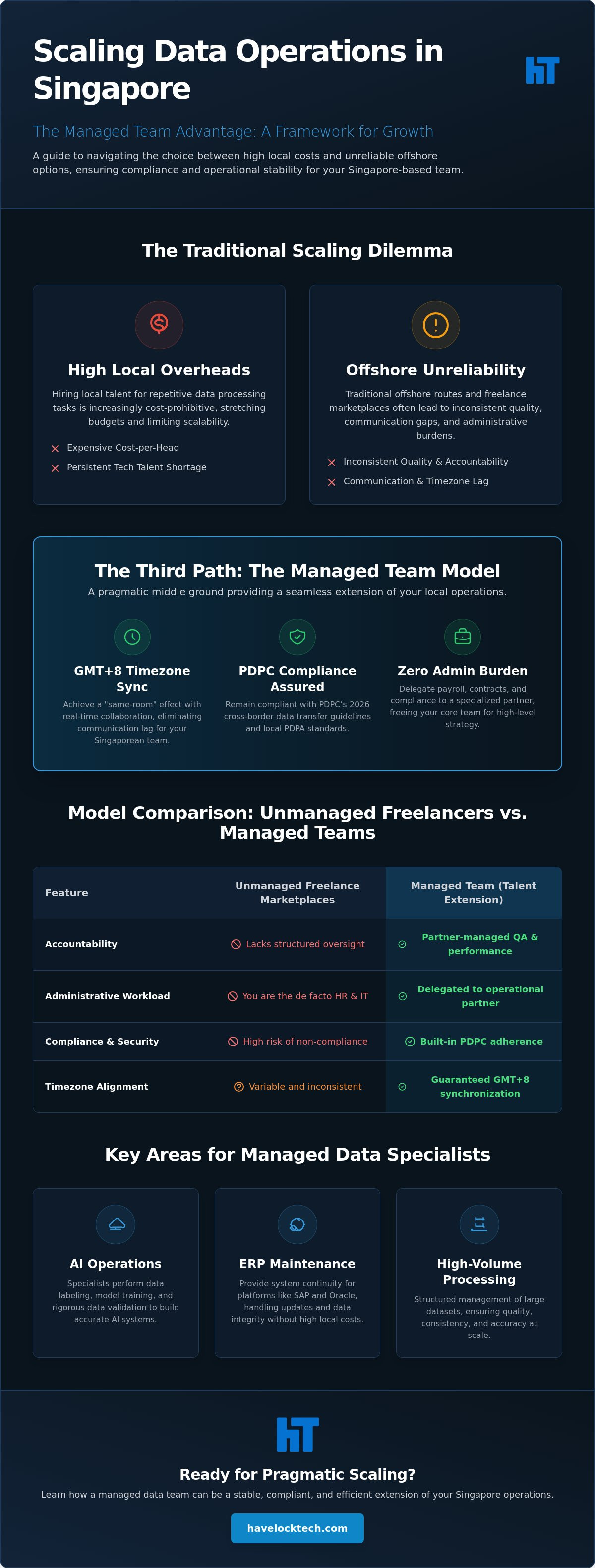
Scaling a data operation in Singapore has become as much a regulatory and administrative challenge as it is a technical one. You likely already know that hiring local talent for repetitive processing tasks is increasingly cost-prohibitive, yet the traditional offshore route often leads to inconsistent quality and communication gaps. It's a frustrating trade-off between high overheads and low reliability. Integrating a managed data processing team offers a pragmatic middle ground, providing the specialized support you need without the burden of offshore payroll or the risk of non-compliance with the PDPC’s 2026 cross-border data transfer guidelines.
You deserve a solution that functions as a seamless extension of your local operations, operating within the GMT+8 timezone to ensure real-time synchronization. This article provides a comprehensive framework to help you evaluate and scale remote data specialists effectively. We will examine the critical criteria for choosing a partner who handles the logistical heavy lifting, from contract management to quality assurance. This ensures your core team stays focused on high-level strategy while the operational mechanics are handled with professional precision and stability.
Key Takeaways
- Understand the distinction between unmanaged freelance marketplaces and a structured talent extension model to ensure operational stability.
- Prioritize GMT+8 alignment to achieve a "same-room" effect, which enables real-time collaboration and eliminates communication lag for your Singaporean team.
- Learn to establish output-based KPIs that allow you to scale your managed data processing team without increasing your internal administrative workload.
- Ensure your remote operations remain compliant with the PDPC’s 2026 cross-border data transfer guidelines and local PDPA standards.
- Identify how to remove the "noise" of offshore hiring by delegating payroll, contracts, and compliance to a specialized operational partner.
Beyond Headcount: What Are Managed Remote Data Specialists?
Scaling a technical operation in Singapore often presents a binary choice. You either hire expensive local staff or you gamble on unmanaged freelancers from global marketplaces. Neither option is ideal for long-term operational stability. A managed data processing team offers a third path, providing the technical precision of a local hire with the logistical efficiency of a remote model. Managed remote data specialists are integrated team members supported by an external administrative backbone. This structure ensures that while the specialists work directly within your workflows, the complexities of their employment remain external to your core business.
Singaporean companies are increasingly moving away from unmanaged freelance marketplaces because these platforms lack accountability. When you hire an unmanaged freelancer, you become the de facto HR manager, IT support, and quality assurance lead. This creates an administrative burden that often outweighs the cost savings. By contrast, a managed model integrates these specialists into your team as a "talent extension." You maintain control over the "what" and "how" of the work, while your partner handles the "noise" of recruitment, payroll, and infrastructure. To understand the foundational shift in this business model, it's helpful to look at what are managed services and how they differ from traditional project-based outsourcing.
The Evolution of Data Support in Singapore
The market in Singapore has matured beyond seeking the lowest possible price point. Operations leaders now prioritize reliability and geographic alignment. The persistent tech talent shortage in the city-state means local teams are often stretched thin by repetitive but critical data tasks. Shifting these responsibilities to a partner in the GMT+8 region allows for real-time synchronization. It transforms the role from "cheap labor" into "integrated expertise." This shift is pragmatic; it allows your local engineers to focus on high-level architecture while the managed data processing team handles the essential operational volume.
Key Functional Areas for Remote Data Teams
These specialists provide dedicated support across several high-stakes domains. They don't just enter data; they manage it within your existing systems. Key areas include:
- AI Operations: Specialists perform data labeling, model training, and rigorous data validation to ensure your AI systems are built on accurate foundations.
- ERP Maintenance: They provide the oversight needed for system continuity, handling updates and data integrity without the high cost of local administrators.
- High-Volume Processing: Moving beyond simple entry, these teams provide structured management of large datasets, ensuring quality and consistency at scale.
This managed approach provides a "safe pair of hands" for your data. It allows you to scale up or down based on project demands without the friction of traditional hiring cycles or the risks of unmanaged remote work.
The 5-Point Checklist for Evaluating Managed Specialists
Moving from a traditional hiring model to a talent extension requires a shift in how you evaluate potential partners. It's not enough to simply review a resume; you must assess how a managed data processing team will integrate into your existing operational rhythm. A successful partnership relies on a combination of technical capability and administrative reliability. This checklist provides a framework to ensure your remote specialists are an asset rather than an additional management burden.
Vetting Technical vs. Operational Fit
Technical skills are the baseline, but operational compatibility determines long-term success. When you evaluate individual specialists, look for these specific indicators:
- Tech Stack Alignment: Verify that the specialists have hands-on experience with your specific tools, whether it's managing data within SAP and Oracle or utilizing Python for automated processing tasks.
- Communication Clarity: Assess their ability to participate effectively in daily stand-ups. They must be able to articulate progress and roadblocks clearly to maintain momentum.
- Data Governance Standards: Ensure they understand the principles of quality assurance and data integrity. They should be familiar with maintaining high standards of accuracy in high-volume environments.
Evaluating the Managed Service Provider (MSP)
The provider acts as the operational backbone of your remote team. Their role is to handle the "noise" so you can focus on execution. When vetting an MSP, prioritize these three areas:
- Timezone Synchronization: For Singapore operations, GMT+8 alignment is non-negotiable. Synchronous working hours allow for real-time collaboration and immediate troubleshooting, which prevents the "delay-and-fix" cycle common with other offshore models.
- Administrative and Legal Compliance: The provider must take full responsibility for contracts, payroll, and adherence to local labor laws in the specialist's jurisdiction. This removes the legal complexity from your plate.
- Security and Data Privacy: Confirm their protocols for handling sensitive corporate information. A reliable partner will have established frameworks that align with Singapore’s rigorous data protection expectations.
Scalability is the final piece of the puzzle. Your partner should offer the flexibility to add new roles or pivot existing ones as your project requirements evolve. This agility allows you to respond to market changes without the friction of a new recruitment cycle. If you're looking for a partner that prioritizes this level of operational stability, you can explore how to scale your data operations with a focus on reliability and GMT+8 alignment. By following this structured evaluation, you ensure that your managed team provides a "safe pair of hands" for your daily data needs.
Operational Integration: Making Remote Teams Feel Local
Integration is the stage where most remote partnerships either solidify or fail. For a Singaporean operations leader, the goal is to ensure a managed data processing team functions as a natural extension of the core office rather than a siloed department. This requires moving beyond simple task delegation toward a model of real-time collaboration. When your remote specialists start their day at the same time as your local engineers, the psychological and operational barriers of "offshore" work begin to disappear.
The Advantage of GMT+8 Synchronization
Relying on teams in Europe or North America often results in a 12-hour lag that stifles productivity. A developer in Singapore might flag a data error at 4:00 PM, only to wait until the next morning for a response. Working within the GMT+8 timezone eliminates this "wait-until-tomorrow" delay entirely. It allows for immediate feedback loops during critical QA cycles and data validation phases. Operating within the same temporal window reduces the management tax by approximately 40% because it eliminates the need for asynchronous handovers and redundant documentation.
Synchronous hours also mean your remote staff can participate in your existing office culture. They aren't just names on a spreadsheet; they're active participants in your Slack channels and Jira boards. This alignment ensures that when a pivot is required, the entire team receives the information simultaneously. It prevents the fragmentation of knowledge that often plagues unmanaged remote setups.
Tools and Workflows for Data Transparency
Transparency is maintained through a combination of shared infrastructure and rigorous reporting. Your managed data processing team should operate within your secure environment, utilizing your own VPNs and access controls to maintain data sovereignty. This setup ensures that all processing happens within your oversight, which is essential for meeting internal security audits and regulatory requirements.
Measuring success requires clear, output-based KPIs. Rather than tracking hours worked, focus on concrete metrics that reflect the health of your data pipeline. Consider implementing the following trackers:
- Throughput: The volume of data records accurately processed within a single shift.
- Accuracy Rate: The percentage of records passing automated and manual quality assurance checks.
- Turnaround Time: The speed at which data moves from initial ingestion to a finalized, usable state.
Establishing a rhythm of daily morning stand-ups via video call reinforces accountability. These brief sessions allow local leads to clarify priorities and remote specialists to report on completed tasks. It creates a predictable cadence that builds trust and ensures that everyone remains aligned with the broader operational objectives of the company.
Mitigating Risks: Security, Compliance, and the Freelancer Trap
Direct hiring of offshore freelancers often appears cost-effective during the initial budgeting phase. However, many Singaporean operations leaders quickly discover the "freelancer trap," where the administrative overhead and legal risks outweigh the salary savings. Without a corporate buffer, your internal HR and legal teams must navigate foreign labor laws, international tax withholding, and the complexities of cross-border benefits. A managed data processing team eliminates these friction points by providing a structured framework where the provider assumes all employer-of-record responsibilities.
Managing compliance is a full-time operational requirement, not a one-time setup task. When you bypass a managed partner, you take on the liability for every data interaction. A professional service provider acts as a de-risking layer, ensuring that your remote specialists are integrated into a secure, accountable system. This allows your local team to focus on high-level data strategy while the logistical complexities of international employment are handled by a dedicated operational backbone.
The Hidden Costs of Unmanaged Offshore Teams
The most significant hidden cost is the "time drain" on your local management. When you hire unmanaged talent, you aren't just buying their time; you're spending your own on their administrative support. Enforcing non-disclosure agreements (NDAs) across international borders is notoriously difficult for individual contracts. A managed partner provides a centralized point of accountability, offering a legally enforceable service level agreement that protects your intellectual property. Additionally, turnover risk is mitigated through local support systems provided by the partner, which ensures higher staff retention than a purely transactional freelance relationship.
Security Frameworks for Remote Data Access
Data sovereignty is a critical concern under the 2026 PDPC "Guide to Cross-Border Data Transfers." Singaporean organizations must ensure that any recipient of personal data provides a standard of protection comparable to the PDPA. Relying on a managed data processing team allows you to implement standardized security protocols across your entire remote workforce. This includes:
- Secure Virtual Desktops: Ensuring data never leaves your controlled environment and is never stored on local, unencrypted devices.
- Least Privilege Access: Granting specialists only the specific permissions required for their data processing tasks, which reduces the internal threat landscape.
- Regular Compliance Training: Ensuring all remote personnel are updated on the latest PDPA Amendment Regulations 2026 and your internal security policies.
Compliance shouldn't be an afterthought in your scaling strategy. By using a managed model, you ensure that your remote operations meet the same rigorous standards as your local Singapore office. If you're ready to de-risk your data operations, you can get started with a managed data solution that prioritizes security and administrative simplicity. This approach allows you to scale with confidence, knowing the operational "noise" is handled by a professional facilitator.
The Havelock Tech Model: Pragmatic Scaling for Singapore
Scaling a data operation in Singapore shouldn't feel like a second job for your technical leads. Havelock Tech provides a structured model that removes the administrative "noise" typically associated with remote hiring. By acting as a professional facilitator, we allow your team to treat our specialists as a direct extension of your local office. This "Manager’s Manager" approach ensures that while you define the technical priorities, we handle the operational mechanics that keep the team running smoothly. It's a partnership built on the premise that your core talent should focus on strategy, not offshore payroll or hardware procurement.
Our managed data processing team model is built specifically for the unique demands of the Singapore market. We prioritize GMT+8 synchronization because real-time collaboration is the only way to maintain the high standards required for AI Operations, Quality Assurance, and ERP maintenance. For instance, a data-heavy Singapore enterprise recently reduced its operational friction by transitioning its model training data validation to our managed specialists. This move allowed their local data scientists to stop managing individual contractors and start focusing on model architecture, resulting in a more stable and predictable output cycle.
A "Safe Pair of Hands" for Your Operations
We provide a single, transparent monthly fee that covers recruitment, payroll, and compliance. This consolidation eliminates the need for your finance department to handle multiple offshore contracts or navigate foreign tax regulations. We maintain ongoing oversight of all personnel to ensure they remain productive and aligned with your internal workflows. This oversight includes regular performance check-ins and quality audits that mirror your own internal standards. You can learn more about our approach to Scaling Tech Teams in Singapore: Remote Talent Solutions to see how we maintain this level of operational stability.
Getting Started with a Managed Data Team
Our engagement begins with a pragmatic discovery process to identify your specific data bottlenecks. We don't believe in one-size-fits-all solutions; instead, we match specialists to your exact tech stack and operational rhythm. This focus on precision allows for rapid onboarding, often moving from an identified need to an integrated specialist in weeks rather than months. We handle the logistical heavy lifting, from initial vetting to the setup of secure virtual environments. If you're ready to reduce your administrative burden and focus on growth, you should schedule a consultation to build your managed data team today. We act as the reliable backbone of your remote operation, ensuring you have the capacity to scale without the typical growing pains of offshore expansion.
Securing Operational Stability for Your Data Pipeline
Scaling your data operations doesn't have to mean increasing your administrative workload. By prioritizing GMT+8 alignment and a structured management model, you can transform remote support from a source of friction into a reliable talent extension. Transitioning to a managed data processing team ensures that your core local engineers remain focused on high-level architecture while the essential volume of data processing is handled with professional precision and calm assurance.
A successful partnership hinges on removing the "noise" of offshore hiring. When you delegate the complexities of payroll, contracts, and regional compliance to a seasoned facilitator, you gain the stability needed to scale without the typical risks of unmanaged remote work. Havelock Tech specializes in this pragmatic integration, providing dedicated personnel who function as a seamless part of your existing team within your specific timezone.
If you're ready to secure a "safe pair of hands" for your daily operations, you can Build your managed data team with Havelock Tech. We handle the logistical heavy lifting and full administrative management so you can focus on your primary objectives. We look forward to helping you build a more resilient and efficient operational backbone.
Frequently Asked Questions
What is the difference between a managed remote specialist and a freelancer?
A managed remote specialist is an integrated team member supported by a professional administrative backbone, whereas a freelancer operates as an independent, unmanaged entity. This means your managed data processing team is supervised by us for attendance and basic quality standards, while you retain full control over their technical priorities. We handle the "noise" of HR, equipment, and infrastructure so you don't have to manage the logistics of remote work.
How does Havelock Tech handle offshore payroll and compliance?
We act as the Employer of Record, managing all local tax, benefits, and labor law compliance in the specialist's jurisdiction. You receive a single, transparent invoice in S$ each month, which eliminates the need for your finance team to navigate foreign tax codes or international wire complexities. This structure provides a de-risked path for scaling your operations across borders without the administrative burden.
Can I interview the data specialists before they join my team?
You maintain final approval over every specialist who joins your team. Our recruitment team pre-vets candidates based on your specific requirements and tech stack, but we encourage you to conduct final technical interviews. This ensures the specialist understands your specific workflows and fits your internal communication style before they begin the onboarding process.
Why is working in the GMT+8 timezone so important for Singapore companies?
GMT+8 synchronization is critical because it enables real-time collaboration during your core business hours. Working in the same timezone eliminates the 12-hour communication lag common with European or US-based offshore teams. It allows your remote specialists to join morning stand-ups and provide immediate responses to urgent data validation requests or QA issues as they arise.
What technical areas do your remote data specialists cover?
Our specialists provide dedicated support for AI operations, data processing, QA talent, and ERP support. This includes specialized tasks such as data labeling for machine learning models, structured data cleaning, and maintaining system integrity within ERP environments like SAP or Oracle. We focus on high-utility roles that augment your existing technical capacity and operational speed.
How do you ensure the security of our data with remote staff?
We secure your data by ensuring specialists work within your existing secure infrastructure via VPNs or secure virtual desktops. We enforce "least privilege" access, meaning personnel only have visibility into the data necessary for their specific tasks. Our specialists also receive regular training on PDPA standards to ensure compliance with Singapore’s 2026 data protection guidelines and cross-border transfer regulations.
What happens if a remote specialist is not a good fit for our culture?
We provide a structured replacement process if a specialist doesn't align with your team's culture or performance standards. Because we maintain an active talent pool and handle the administrative exit process, we can transition a new specialist into your workflow with minimal disruption. This ensures your operational momentum remains steady and reduces the stress of turnover.
Is there a minimum contract length for managed remote data teams?
Our engagement models are designed for stability and long-term scaling rather than one-off project work. We typically work with partners who want to build a sustainable managed data processing team that evolves with their business needs. This focus on longevity allows us to invest in the training and integration necessary to make the remote team function as a seamless extension of your local office.