

Can your operational budget realistically sustain a local Oracle expert at an average cost of S$135,478 per year while still maintaining the agility needed for growth? For many Singaporean tech leaders, the answer is increasingly negative. You already know that high recruitment costs and the administrative weight of payroll compliance create a ceiling on your execution capacity. It's a challenge that often leads to deferred maintenance, making the search for reliable remote oracle erp support a top priority for maintaining system continuity.
This article offers a pragmatic guide to integrating managed specialists into your GMT+8 workflows while eliminating the communication lag typical of traditional offshore teams. We'll explore how to synchronize these remote resources with your internal processes, ensuring your Oracle environment remains stable and secure. By the end, you'll understand how to expand your execution capacity and reduce technical debt without increasing your fixed headcount or administrative friction.
Key Takeaways
- Learn how to position remote oracle erp support as a managed extension of your core team to maintain system continuity across Cloud and on-premise platforms.
- Identify the hidden costs of direct recruitment in Singapore and how to calculate an accurate total cost of ownership for your technical talent.
- Discover a structured framework for integrating remote specialists into GMT+8 workflows through functional gap analysis and defined support tiers.
- Understand the operational protocols required to maintain data security and ensure compliance with local regulatory standards such as the PDPA.
- Gain strategies for scaling your technical execution capacity and reducing technical debt without increasing your fixed administrative headcount.
The Strategic Role of Remote Oracle ERP Support in Modern Enterprise
Establishing remote oracle erp support is no longer just a cost-saving tactic; it's a strategic necessity for Singaporean enterprises managing complex digital environments. Modern organizations rely on Enterprise Resource Planning (ERP) systems to integrate core business processes, making these platforms the central nervous system of the company. When these systems falter, the entire operation risks a standstill. By viewing remote support as a managed extension of your core technical team, you gain access to a deep pool of specialized talent that might otherwise be unavailable or prohibitively expensive in the local market.
The local tech talent shortage in Singapore has forced a shift in how leaders approach team building. Instead of focusing solely on headcount management, which carries heavy administrative weight and high recruitment fees, managers are prioritizing execution capacity. This model allows you to scale up functional or technical expertise instantly. It ensures that your Oracle Cloud or on-premise systems receive the continuous oversight they require without the friction of onboarding permanent staff for every specialized niche.
Why System Continuity Requires Dedicated Oversight
Relying on "as-needed" or reactive support creates significant operational risk. When issues are only addressed after they cause a disruption, technical debt accumulates, leading to degraded system performance and increased security vulnerabilities. Dedicated remote personnel provide the consistent monitoring necessary to identify these bottlenecks before they impact the user experience. ERP maintenance is a proactive, not reactive, function that preserves the long-term health of the business environment. This disciplined oversight ensures that patches are applied, configurations are optimized, and the system evolves alongside your business requirements.
The Singapore Context: Navigating the GMT+8 Requirement
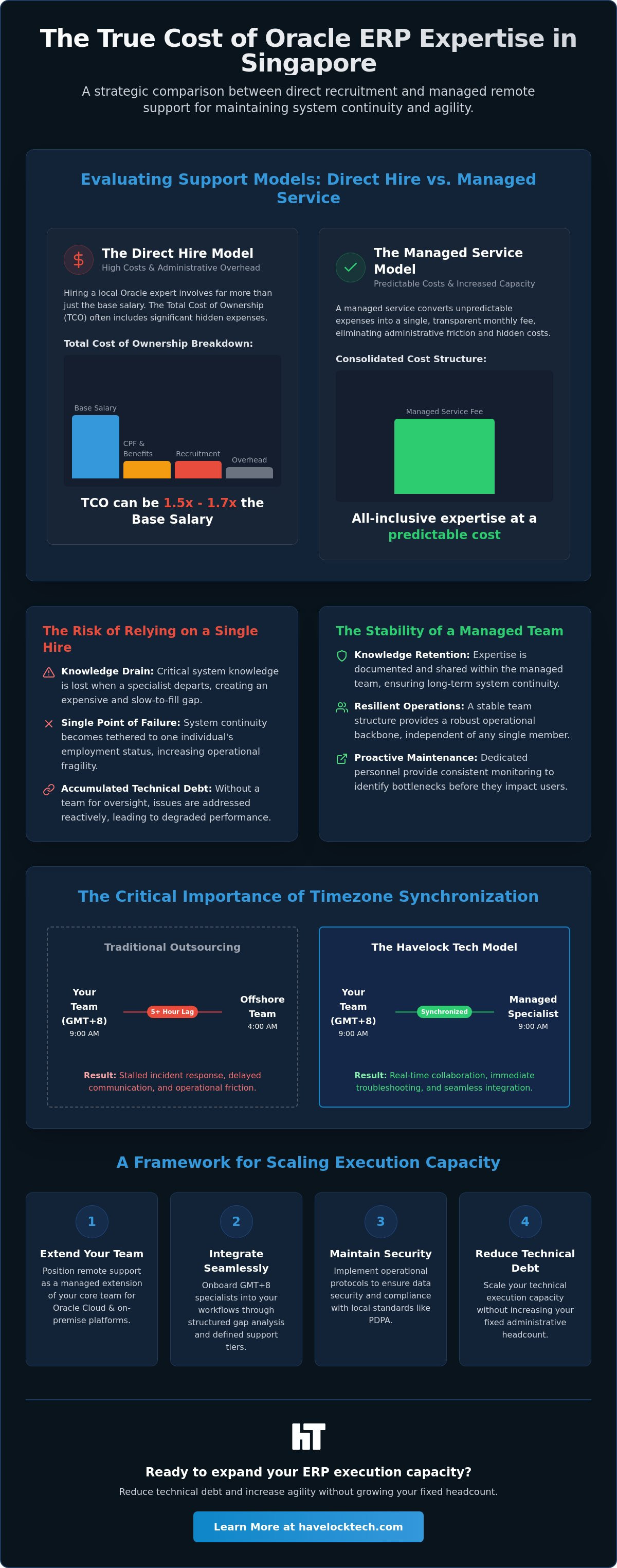
For operations based in Singapore, timezone alignment is the most critical factor in a successful remote partnership. Traditional outsourcing models often suffer from a five-hour or greater time difference, which stalls incident response and makes daily stand-ups nearly impossible to coordinate. This lag creates a disconnect between the remote specialists and the local stakeholders they serve.
Operational friction occurs when your internal team must wait until the late afternoon for a response from an offshore developer. To solve this, Havelock Tech ensures all talent operates within the GMT+8 timezone. This synchronization allows for real-time collaboration, immediate troubleshooting during business hours, and a seamless integration into your existing team meetings. By removing geographic and temporal barriers, remote oracle erp support becomes a reliable, high-utility extension of your professional environment.
Evaluating Support Models: Managed Service Fees vs. Direct Recruitment
Hiring a local Oracle consultant in Singapore involves more than just a base salary, which often averages around S$135,478 annually according to recent industry data. When you factor in Central Provident Fund (CPF) contributions, health insurance, and physical office overhead, the total cost of ownership (TCO) rises significantly. Managed remote oracle erp support offers a streamlined alternative by consolidating these variables into a predictable monthly fee. This model eliminates the hidden costs of direct recruitment, such as the weeks spent sourcing candidates, conducting technical interviews, and performing background checks. These activities consume valuable leadership time that could be better spent on system optimization.
Retention remains a persistent risk in the Singaporean tech market. When a specialized local hire departs, they take critical system knowledge with them, creating a gap that is both expensive and slow to fill. A managed remote oracle erp support model mitigates this risk by providing a stable team structure where knowledge is documented and shared. This ensures that your system continuity isn't tethered to a single individual's employment status, providing a more resilient operational backbone for your enterprise.
The Administrative Burden of Direct Remote Hiring
Managing remote staff directly across international borders introduces significant complexity. Your internal HR and legal teams must navigate foreign labor laws, tax compliance, and cross-border payroll logistics. These back-end mechanics often become a resource drain, distracting from core business objectives. Havelock Tech serves as an administrative buffer, handling the complexities of international employment so your team stays focused on technical execution. This allows you to leverage ERP support specialists without the typical overhead of global staffing.
Managed Team Extension: Priority Control without Admin Friction
Many leaders worry that moving to a remote model means losing control over work priorities. However, a managed team extension differs significantly from traditional project-based outsourcing or unmanaged freelancers. You maintain direct oversight of the specialist's daily tasks and long-term priorities, while the managed service provider ensures quality assurance and delivery standards are met. This structure provides the best of both worlds: the control of an internal hire with the flexibility of a service. Monthly recurring fees also offer better budget predictability than the unpredictable spikes associated with project-based work.
How to Integrate a Remote Oracle Specialist into Your GMT+8 Workflow
Transitioning to a remote oracle erp support model requires a methodical integration strategy that treats remote specialists as full members of your technical ecosystem. The process begins with a comprehensive functional gap analysis of your current Oracle ERP environment. You must identify where bottlenecks occur, whether in financial reporting, human capital management, or supply chain logistics. This assessment allows you to define the specific support tiers your operation requires, ranging from Technical Developers and Functional Analysts to Database Administrators (DBAs).
Once roles are defined, establishing communication protocols is the next priority. For Singapore-based firms, this means ensuring all collaboration occurs within the GMT+8 timezone using tools like Slack, Jira, or Microsoft Teams. Aligning these tools with your local business hours eliminates the "wait time" typically associated with offshore models. Clear Key Performance Indicators (KPIs) should be set early, focusing on measurable outcomes such as system uptime, ticket resolution speed, and the consistency of patch management schedules.
Defining Functional vs. Technical Support Needs
It's vital to distinguish between functional and technical roles to build an effective support pod. A Functional Consultant understands the business logic within modules like Oracle HCM or Finance, helping users navigate workflows and business rules. In contrast, a Technical Developer handles the underlying code, customizations, and integrations. For complex operations, a multi-disciplinary pod that combines both skill sets provides the most comprehensive coverage. This balanced approach ensures that both user-facing issues and deep-system bugs are addressed with equal proficiency.
The First 30 Days: Ensuring a Seamless Handover
The initial month of engagement determines the long-term success of the partnership. A structured onboarding process should mirror your local staff integration, including a formal knowledge transfer from existing teams. Secure access is paramount; you'll need to establish robust VPN connections and granular access controls for your remote Oracle instances. During this phase, the "Manager’s Manager" approach is essential. This involves high-level oversight to ensure the remote talent understands your specific operational nuances and delivery standards. By treating the first 30 days as a collaborative handover rather than a simple task hand-off, you build the foundation for a reliable and high-utility extension of your professional environment.
Mitigating Risks: Security and Synchronization in Remote ERP Management
Security is the primary concern for any tech leader considering an offshore model. The hesitation often stems from the perceived lack of oversight inherent in unmanaged hiring. When you engage unmanaged freelancers, you often inherit a fragmented security posture that places the burden of risk entirely on your internal team. Managed remote oracle erp support solves this by providing vetted personnel who operate within a controlled, professional environment. This model ensures that all technical activities are documented and audited, which is essential for maintaining compliance with Singaporean data regulations like the PDPA. By shifting to a managed model, you replace individual uncertainty with corporate accountability.
The distinction between unmanaged contractors and vetted managed personnel is fundamental to operational stability. Unmanaged workers often use personal devices and unsecured networks, creating significant vulnerabilities for your Oracle environment. In contrast, managed specialists work within secure frameworks that include encrypted tunnels and multi-factor authentication. This structured approach provides a "safe pair of hands" for your most sensitive enterprise data. If you're ready to improve your system security and response times, learn more about our ERP support talent solutions.
Data Governance and Remote Access Protocols
Technical managers must implement the Principle of Least Privilege (PoLP) to restrict access to sensitive Oracle tables. By granting only the permissions necessary for a specific functional task, you significantly reduce the surface area for potential data breaches. Managed service providers facilitate this by setting up secure VPNs and monitored workstations that prevent unauthorized data extraction. This is particularly relevant as Singaporean organizations prepare for the December 31, 2026, deadline to cease using NRIC numbers for user authentication. Havelock Tech talent is subjected to a comprehensive vetting process that includes identity verification, technical screening, and professional reference checks to guarantee operational integrity.
Synchronous Communication: The Key to Operational Stability
Operating in a shared GMT+8 timezone eliminates the communication silos that lead to prolonged system downtime. Traditional outsourcing often results in a 24-hour delay, where a bug reported in the morning isn't addressed until the following night. Synchronous communication allows for immediate incident response and real-time collaboration on complex configurations. This alignment supports agile ERP development, where developers and functional leads can iterate on solutions throughout the Singaporean business day. There is also a distinct psychological benefit to knowing your remote staff is available during your standard working hours, including lunch breaks, for quick syncs or urgent updates. This level of synchronization ensures that your remote team remains a high-utility extension of your local office.
Scaling ERP Execution Capacity with Havelock Tech’s Managed Talent
Establishing remote oracle erp support through Havelock Tech allows Singaporean tech leaders to bypass the logistical friction of traditional hiring. Our model focuses on stability and reliability, ensuring that your system continuity is never compromised by local talent shortages or high turnover rates. We provide a disciplined operational backbone that respects your existing expertise while augmenting your team's output. You maintain full control over work priorities and technical direction, while we manage the administrative complexities of payroll, compliance, and human resources. It's a low-risk, high-utility strategy designed for leaders who value execution over administrative overhead.
The transition to a managed model provides immediate relief for overstretched internal teams. By integrating our specialists, you can reallocate your local high-value assets to strategic initiatives rather than routine maintenance. This shift reduces technical debt and increases your overall execution capacity without the burden of increasing your fixed headcount. Our approach is fundamentally pragmatic, focusing on the mechanics of delivery and the synchronization of global talent with your specific business goals.
Our Approach to Oracle ERP Support Integration
Our integration strategy centers on GMT+8 alignment and deep technical expertise. We understand that timezone synchronization is the primary driver of operational stability for Singapore-based firms. By ensuring our talent operates during your business hours, we eliminate the communication lags that often derail offshore partnerships. Our logistical competence reduces the stress of scaling, providing a "safe pair of hands" for your Oracle environment. In addition to remote oracle erp support, we offer complementary capabilities in AI Operations Support and Data Processing Services, allowing you to scale multiple functional areas through a single, reliable partner.
Next Steps: From Strategy to Execution
Moving from strategy to execution requires a clear understanding of your current support gaps. We encourage you to assess your technical requirements and define the specific tiers of support your organization needs to maintain peak performance. Our deployment timeline is designed for speed and efficiency, allowing you to integrate managed specialists into your workflow with minimal disruption. If you're ready to stabilize your Oracle environment and expand your team's reach, we invite you to contact Havelock Tech to extend your ERP support team. Let's discuss how a managed extension can provide the stability and scale your Singaporean operations require.
Strengthening Your Oracle ERP Infrastructure for Future Growth
Transitioning to a managed model for remote oracle erp support provides the operational relief necessary to maintain complex systems without the friction of local recruitment. By prioritizing GMT+8 timezone alignment, your organization ensures that technical specialists are available when your internal stakeholders need them most. This synchronization prevents the communication lags that often hinder offshore partnerships, allowing your team to focus on high-level strategy rather than daily troubleshooting. It's a pragmatic shift that balances cost-efficiency with high-level technical execution.
A dedicated team extension model handles the complexities of payroll, compliance, and administrative overhead, offering a stable and scalable solution for Singaporean tech leaders. You gain a safe pair of hands that respects your existing expertise while providing the logistical competence required for long-term system continuity. If you're ready to optimize your technical environment, increase your execution capacity with managed Oracle ERP support. Implementing these structured protocols today will ensure your enterprise remains resilient and prepared for the evolving demands of the digital landscape. Your path to a more agile and efficient ERP operation starts with a commitment to reliable, managed talent.
Frequently Asked Questions
Is remote Oracle ERP support as effective as having an on-site team?
Remote support is highly effective when integrated as a managed extension of your team rather than a disconnected vendor. Success depends on real-time collaboration and shared documentation rather than physical proximity. By maintaining constant communication through digital tools, remote specialists provide the same level of oversight and incident response as an on-site team. This approach ensures system continuity without the high costs of local recruitment.
How does Havelock Tech ensure remote staff work in the Singapore timezone?
We guarantee GMT+8 alignment by making it a core requirement of our talent selection and management process. Specialists are contracted specifically to work Singaporean business hours, ensuring they're available for daily stand-ups and urgent troubleshooting. This synchronization eliminates the communication lag that typically hampers traditional offshore models. It provides your local team with immediate access to expertise throughout the standard workday.
Can remote Oracle specialists handle both Cloud and on-premise versions?
Our talent pool includes specialists proficient in both Oracle Cloud (Fusion) and on-premise E-Business Suite environments. We conduct a functional gap analysis to ensure the remote oracle erp support you receive matches your specific architecture. This technical flexibility allows you to maintain legacy systems while transitioning to cloud-native solutions. We vet every specialist for their specific experience in your required environment.
What is the typical onboarding time for a managed remote ERP specialist?
The typical onboarding process for a managed specialist takes between two and four weeks. This timeframe includes the final technical screening, secure access setup, and initial knowledge transfer. A structured approach ensures the specialist is fully integrated into your workflow and understands your operational standards before they begin high-impact tasks. This rapid deployment helps you address support gaps without long recruitment delays.
How are payroll and local compliance handled for remote staff?
Havelock Tech handles all cross-border payroll, tax compliance, and local labor law requirements. You receive a single monthly invoice, which removes the administrative burden from your internal HR and finance teams. This administrative buffer allows you to scale your technical capacity without increasing your fixed administrative headcount. We manage the back-end mechanics so you can focus on work priorities and system performance.
What happens if the specific Oracle ERP module we use is highly specialized?
We match talent to your specific module requirements, whether you use Oracle HCM, Finance, or Supply Chain. During the initial consultation, we identify the functional expertise needed for your environment. If your system requires a niche specialization, we leverage our vetted talent network to find a specialist with the precise experience required. This ensures that even highly customized modules receive expert oversight and maintenance.
How does Havelock Tech manage the quality of work for remote personnel?
We manage quality through a combination of clear KPI tracking and regular performance reviews. We monitor metrics such as ticket resolution speed, system uptime, and patch management consistency to ensure delivery standards remain high. This oversight provides the manager’s manager layer that ensures your work priorities are met with professional accountability. You maintain control over the tasks while we ensure the execution meets your expectations.
Can we scale the remote team up or down based on project needs?
The managed team extension model is designed to be flexible, allowing you to adjust your execution capacity as project demands change. You can scale your remote oracle erp support team up for major upgrades or down during periods of stable maintenance. This flexibility ensures your budget remains predictable while providing the resources needed for business growth. It's a pragmatic way to manage technical debt without long-term hiring commitments.