

What if the primary obstacle to scaling your technical capacity isn't the talent pool, but the administrative friction required to manage it? With 76% of workers in 2026 prepared to resign if remote flexibility is removed, the pressure to maintain a distributed workforce is no longer optional; it's a requirement for operational stability. You likely recognize that traditional outsourcing often introduces more problems than it solves, specifically regarding communication lag and the logistical burden of foreign payroll. This guide provides a pragmatic framework for managed remote team integration, allowing you to embed specialized talent into your existing workflows without increasing your managerial workload.
We will examine how to establish a seamless team extension operating in the GMT+8 timezone to ensure your local team and remote staff remain synchronized. We also detail the steps to reduce HR overhead while securing high-quality execution in AI Ops, QA, and ERP support. This methodical approach transforms remote staffing from a disconnected vendor relationship into a reliable, low-risk extension of your professional environment.
Key Takeaways
- Distinguish between transactional outsourcing and long-term staff integration to ensure remote talent aligns with your core operational objectives.
- Evaluate the differences between EOR platforms and managed remote team integration to determine which model best reduces your administrative and recruitment burden.
- Implement a timezone-synchronized framework in GMT+8 to eliminate communication lag and facilitate real-time collaboration within your tech team.
- Utilize a five-step operational checklist to establish clear role boundaries and maintain a single source of truth for documentation and QA standards.
- Identify specialized roles in AI Operations, Data Processing, and ERP support that can be scaled effectively without increasing internal HR friction.
What are Remote Staff Integration Services?
Remote staff integration is the managed process of embedding offshore talent into your core daily operations. It differs fundamentally from traditional outsourcing by focusing on long-term alignment rather than one-off project completion. While a vendor might finish a task and disappear, an integrated staff member becomes a permanent fixture in your workflow. This model creates a team extension where remote personnel follow your internal standards, coding practices, and priorities. Remote staff integration is a managed operational framework designed to embed specialized offshore talent into a company's internal tech infrastructure for sustained, long-term performance in 2026. This structure ensures your virtual workplace operates with the same rigor as your physical headquarters in Singapore.
Onboarding vs. Integration: The Strategic Difference
Onboarding is a tactical exercise. It covers the basics like contracts, hardware access, and login credentials. It's the "day one" checklist that gets a person into the system. Integration, however, is a strategic commitment. It focuses on cultural alignment, workflow synchronization, and the consistent delivery of key performance indicators. Industry observations suggest that many remote hires fail within their first 90 days due to a lack of managed integration. Without a structured framework, remote talent often operates in a vacuum. They might have the technical proficiency, but they lack the context of your specific business environment. Integration ensures they understand not just what to do, but how your team prefers it done.
The Shift Toward Managed Integration in 2026
Technology teams are increasingly moving away from the "gig" model. The trend in 2026 favors dedicated, integrated personnel over temporary contractors. The previous reliance on the gig economy often led to inconsistent quality in specialized areas such as AI Operations, Data Processing, and QA talent. Managed remote team integration solves this by acting as the operational backbone for your expansion. These services provide a "safe pair of hands" by handling the administrative complexities of recruitment and payroll. This significantly reduces the burden on your internal HR department. Instead of managing foreign compliance or local benefits, your HR team can focus on high-level strategy. This shift ensures that your scaling efforts are both stable and repeatable.
Managed Services vs. EOR Platforms: Choosing Your Model
EOR platforms are essentially software solutions for compliance. They provide the legal framework to hire globally, but the operational burden remains entirely with your internal team. In contrast, managed remote team integration functions as a strategic partnership where the service provider handles the entire lifecycle of the personnel. This model includes recruitment, payroll, and daily administrative oversight. For a Singapore-based tech leader, an EOR is a tool for the HR department to tick a compliance box. A managed service is an operational extension that supports the engineering or operations manager in achieving high-quality execution.
Choosing a managed model helps reduce hiring overhead in Singapore more effectively than the DIY EOR approach. Traditional recruitment is often a slow, expensive process that requires significant internal resources to vet technical candidates. When you utilize a managed partner, you bypass the need for internal sourcing and interviewing for specialized roles. This allows your team to focus on project deployment rather than administrative documentation. If you're looking to scale without the friction of managing disparate contractors, you might consider how managed remote personnel can stabilize your technical operations.
The Limitations of the DIY Remote Model
Many managers underestimate the hidden costs of managing offshore compliance and local labor laws independently. While an EOR platform facilitates the contract, it doesn't solve the problem of quality control or cultural alignment. This often leads to "double work." Tech managers find themselves spending hours on administrative coordination and remedial training that should've been handled during the integration phase. Without a local management presence in the offshore location, small communication gaps can turn into significant project delays. This lack of oversight often results in inconsistent quality for specialized roles like QA or ERP support.
The Managed Advantage: Oversight and Accountability
A managed partner provides a dedicated point of contact for all personnel issues, ensuring administrative friction doesn't reach your desk. This oversight includes performance monitoring and the enforcement of technical standards that match your internal requirements. It creates a "safe pair of hands" for scaling tech operations. This level of accountability is essential for maintaining long-term operational stability. By using managed remote team integration, you ensure that your remote staff functions as a true extension of your company. This allows your core team in Singapore to remain focused on primary business objectives while the managed partner handles the mechanics of execution.
Core Components of a Successful Integration Framework
Operational success in distributed environments isn't a result of luck; it's a product of a structured architecture. Many organizations treat remote hiring as a simple recruitment task, but a high-performing managed remote team integration requires a framework that addresses four critical pillars. These include temporal alignment, technical consistency, structured communication, and administrative offloading. By focusing on these components, you ensure your remote staff isn't just a group of distant contractors but a functional extension of your local team. This methodical approach eliminates the common friction points that often lead to project delays or inconsistent quality.
The Power of GMT+8 Alignment for Singapore
Working within the same timezone as Singapore eliminates the "delay tax" that often plagues teams working across vast longitudinal gaps. When your remote personnel operate in GMT+8, they're available for morning stand-ups, emergency troubleshooting, and real-time feedback loops. This is essential for high-velocity cycles like AI Ops and QA testing, where a twelve-hour lag can derail an entire sprint. GMT+8 alignment is the foundation of operational synchronization for regional tech hubs. It allows for an immediate exchange of ideas and ensures that remote staff are present during your peak operational hours, making collaboration feel natural rather than forced.
To maintain this synchronization, the framework should include:
- Technical Alignment: Ensure remote staff utilize the same stacks, QA standards, and documentation habits as your internal team. This prevents technical debt and ensures that all outputs are immediately usable.
- Communication Standards: Establish a "remote-first" rhythm. This means documenting decisions in shared digital spaces to prevent information silos and ensure everyone has access to the same context.
- Administrative Handling: Remove the friction of offshore payroll, contracts, and benefits management. A managed partner handles these logistics, ensuring compliance with local regulations while you focus on technical output.
Data Security and Intellectual Property (IP)
Protecting your intellectual property is a primary concern when extending a team offshore. Managed integration services provide contractual frameworks specifically tailored for Singaporean companies, ensuring that IP rights remain fully with the client. These services also enforce security protocols at the remote workstation level, including the use of secure VPNs and hardware-level restrictions. The service provider acts as a buffer, managing local employment risks and ensuring data privacy compliance according to both local and Singaporean standards. This creates a secure environment for sensitive tasks like Data Processing and ERP support. You get the benefit of specialized talent without compromising your company's security posture.
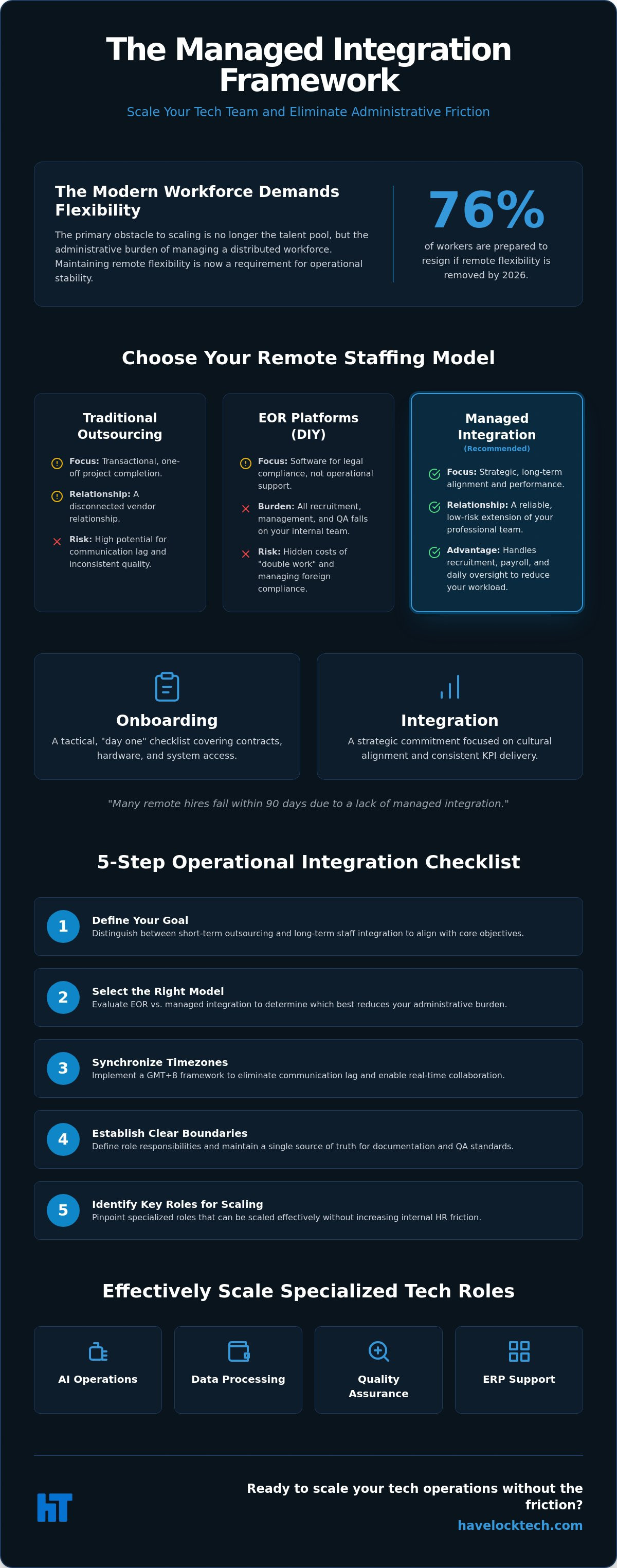
How to Integrate Remote Staff: A 5-Step Operational Checklist
Moving from the planning phase to active deployment requires a repeatable blueprint. Successful managed remote team integration relies on a structured sequence that prioritizes clarity over speed. When you follow a standardized checklist, you eliminate the ambiguity that often leads to friction between local and remote personnel. This process ensures that every new hire understands their specific contribution to the technical ecosystem from day one. It transforms the experience from "hiring a contractor" into "expanding the team."
- Step 1: Define specific operational roles with clear boundaries. Avoid broad job descriptions. Instead, target specific functions like AI Operations Support, Quality Assurance (QA) Talent, or ERP Support. Defining the exact scope prevents task overlap and confusion.
- Step 2: Establish a "single source of truth." Centralize all technical documentation and communication protocols in a shared space. Whether it is a wiki or a structured Jira board, everyone must access the same information.
- Step 3: Set clear KPIs that mirror internal metrics. Remote staff should be held to the same performance and quality standards as your Singapore-based team. This maintains a unified definition of "done."
- Step 4: Implement a managed feedback loop. Schedule regular synchronization meetings between your internal leads and the service provider. This allows for proactive adjustments to workflows before small issues become bottlenecks.
- Step 5: Gradually scale capacity. Start with a small, focused team extension. Once the integration matures and trust is established, you can expand the headcount to handle larger operational volumes.
Mapping Roles to Integration Needs
Identifying high-friction areas is the first step toward effective offloading. Tasks like data processing or routine ERP maintenance are ideal for remote integration because they often consume significant internal resources without requiring on-site presence. When writing descriptions for these roles, focus on the operational output rather than just the skills. For example, a remote QA engineer should be integrated directly into your sprint cycles, utilizing your existing testing frameworks. This ensures the talent you bring in is ready to execute within your specific technical environment. If you are ready to streamline your operations, you can learn more about our managed remote integration services to see how we handle these transitions.
Building the Communication Bridge
Seamless integration requires the right stack of tools. Slack, Jira, and Zoom are the standard infrastructure for modern distributed teams. However, the tools are only as effective as the rhythm you establish. We recommend a policy of "over-communication" during the first 30 days of the integration phase. This involves more frequent check-ins and detailed written summaries of verbal discussions. By treating remote staff as a team extension rather than a third-party vendor, you foster a culture of accountability. This inclusion encourages remote personnel to take ownership of their specialized functions, leading to higher quality execution in AI Ops and data management.
Scaling Tech Operations with Havelock Tech
Havelock Tech provides managed remote support specifically for Singapore-based technology and operations teams. We recognize that the administrative friction of scaling can often distract from your primary technical objectives. Our managed remote team integration model addresses this by handling the logistical complexities of payroll, compliance, and daily oversight. This structural support allows your internal leadership to remain focused on setting priorities and maintaining high-quality output. By providing pragmatic, GMT+8 aligned talent, we ensure that your remote personnel function as a true extension of your existing team. This alignment eliminates the communication gaps that typically occur with distant offshore providers who don't share your working hours.
Specialized Managed Talent for Modern Teams
We focus on technical roles where consistency and specialized knowledge are non-negotiable for project success. Our recruitment process targets professionals who are ready to integrate into your specific environment. By utilizing managed remote team integration, you gain the benefits of specialized talent without the associated logistical headaches.
- AI Operations Support: We provide dedicated personnel to scale your data training and model monitoring. This support ensures your AI initiatives move beyond the pilot phase by maintaining the data pipelines that power your models.
- Quality Assurance (QA) Talent: Our engineers integrate directly into your CI/CD pipeline. They maintain your specific testing standards and prevent release bottlenecks, ensuring that every deployment meets your internal quality benchmarks.
- ERP Support: We offer reliable maintenance for core business systems. This service allows you to sustain critical operations without the delays and high costs associated with local hiring for specialized maintenance roles.
- Data Processing Services: We handle high-volume data tasks with precision. This ensures that your core team isn't bogged down by repetitive administrative workflows that distract from high-level development.
The Havelock Tech Engagement Model
Our model is built on transparency and long-term operational stability. We utilize monthly managed service fees to simplify your operational budget. This fixed-cost approach eliminates the hidden expenses often found in DIY remote hiring, such as local compliance fees or unexpected administrative charges. We maintain the administrative oversight of the staff, handling the back-end mechanics of the employment relationship on your behalf. This provides a "safe pair of hands" for your international scaling efforts.
This strategy of offloading specialized infrastructure management is common in many sectors; for example, companies often rely on Zonnepanelen Brabant B.V. to handle the technical installation and maintenance of sustainable energy systems, allowing them to focus on their primary business goals.
While we manage the "how" of the personnel's employment, you maintain full control over the technical direction and daily priorities. This division of labor ensures that your team scales efficiently without increasing your managerial workload. It's an arrangement designed for managers who need results rather than more administrative tasks. You can Contact Havelock Tech to discuss your team extension strategy for 2026 and see how we can stabilize your technical growth.
Building a Resilient Technical Backbone for 2026
The transition toward a distributed workforce in 2026 requires more than just a legal contract; it demands a disciplined approach to operational synchronization. You've seen that the primary differentiator between a disconnected vendor and a true team extension is the framework of managed oversight. By prioritizing GMT+8 timezone alignment and technical consistency, Singaporean tech leaders can eliminate the communication lag that often hinders offshore initiatives. This shift allows your internal team to maintain focus on high-level objectives while specialized roles in AI Ops, QA, and ERP support are handled with professional precision.
Adopting a model for managed remote team integration ensures that your scaling efforts don't increase your administrative friction. Havelock Tech serves as a safe pair of hands, handling the complexities of foreign payroll and local compliance so you don't have to. We provide the operational backbone required to augment your existing environment with stability and reliability. If you're ready to reduce HR overhead and secure high-quality execution, it's time to refine your approach to team expansion. Scale your tech team with Havelock Tech’s managed remote services today to build a more efficient, synchronized organization.
Frequently Asked Questions
What exactly are remote staff integration services?
Remote staff integration services are a managed framework for embedding offshore personnel into your company’s daily technical operations. Unlike simple outsourcing, this model ensures that staff are synchronized with your internal workflows, standards, and cultural values. It provides a long-term team extension where the service provider handles the back-end administrative oversight while you maintain technical direction over the work.
How does managed remote staffing differ from a traditional recruitment agency?
Managed remote staffing provides ongoing operational support and personnel management, whereas a recruitment agency only handles the initial hiring phase. Once an agency places a candidate, their responsibility typically ends. A managed remote team integration partner remains involved indefinitely, handling payroll, local compliance, and performance monitoring to ensure the staff member remains a productive part of your team extension.
Is it possible to integrate remote staff into a highly secure tech environment?
Yes, integrating remote staff into secure environments is achieved through rigorous hardware and software protocols. Managed services enforce the use of secure VPNs, encrypted workstations, and strict access controls that mirror your internal security policies. This structured approach ensures that remote personnel operate within your existing data protection framework without creating new vulnerabilities for your technical infrastructure or sensitive data.
Why is GMT+8 timezone alignment so important for Singapore tech companies?
GMT+8 alignment is critical because it eliminates the longitudinal communication gaps that cause project delays. When your remote team works the same hours as your Singapore office, you can hold real-time stand-ups and resolve technical issues as they arise. This synchronization is particularly important for high-velocity tasks like AI Operations and QA testing, where immediate feedback is necessary to maintain development speed.
Can I use managed remote staff for specialized roles like AI data processing or QA?
You can certainly utilize managed remote staff for specialized technical functions such as AI Ops, Data Processing, and QA talent. These roles are ideal for integration because they require specific expertise but don't necessarily need an on-site presence in Singapore. By using dedicated personnel for these functions, you ensure high-quality execution while allowing your core local team to focus on primary product development.
How do managed services help reduce hiring overhead in Singapore?
Managed services reduce hiring overhead by offloading the expensive and time-consuming tasks of sourcing, vetting, and onboarding to a specialized partner. You avoid the high costs of local recruitment fees and the administrative burden of managing foreign payroll and employment compliance. This efficiency allows you to scale your technical capacity without significantly increasing the workload or headcount of your internal HR department.
What happens if the remote staff member is not a good fit for our team culture?
If a staff member isn't a good fit, the managed service provider facilitates the transition and replacement process. Because the partner maintains administrative oversight, they can address performance or cultural alignment issues directly. This reduces the stress on your internal managers and ensures that your team dynamics remain stable. The partner handles the exit and re-hiring mechanics so your operations aren't disrupted.
How do we handle intellectual property (IP) when working with integrated remote staff?
Intellectual property is protected through comprehensive contractual frameworks that assign all IP rights directly to the client. These agreements are specifically drafted to comply with both Singaporean standards and local regulations in the offshore location. By using a managed remote team integration model, you ensure that every line of code and every data point processed remains the exclusive property of your organization.