

For Singaporean tech leaders, scaling a team presents a complex challenge. The goal is to increase operational capacity without simultaneously increasing administrative friction and management overhead. While adding local headcount is essential for core strategic roles, the process involves more than just salary considerations. The total investment includes recruitment cycles, infrastructure costs, and significant administrative responsibilities that can divert senior leadership from mission-critical objectives.
This guide provides a pragmatic framework for understanding and reducing hiring overhead in Singapore. It moves beyond a simple salary comparison to explore the Total Cost of Ownership (TCO) associated with scaling a team. We will examine the primary drivers of operational overhead and evaluate different models for augmenting your workforce. The focus is not on replacing local talent, but on complementing your core Singaporean team with dedicated, managed remote support, allowing your key experts to focus on high-value innovation.
Calculating the Total Cost of Ownership (TCO) for Singapore Tech Hires
To make informed scaling decisions, it's crucial to understand the Total Cost of Ownership (TCO) of any new hire. TCO encompasses not just the gross salary but also all associated statutory contributions, operational support costs, and administrative time. Relying solely on base salary figures for budget planning can be misleading, as it overlooks the substantial overhead required to support each team member in Singapore.
This overhead includes direct costs like recruitment agency fees, which often amount to 20-30% of a role's first-year salary, and indirect costs such as the administrative time spent on payroll and compliance. By calculating the full TCO, tech leaders can gain a more accurate picture of their investment and identify opportunities for strategic efficiency.
The Full Investment: Statutory Contributions and Insurance
Employing talent in Singapore involves mandatory contributions that are a vital part of the nation's social framework. These are not "burdens" but necessary components of responsible employment. For budget and administrative planning, they include:
- Central Provident Fund (CPF): Employers are required to make monthly CPF contributions for all eligible local employees. These rates are subject to specific caps and can change, requiring ongoing diligence from HR and finance teams to ensure compliance. (Note: 2026 rates should be verified closer to the time of publication.)
- Skills Development Levy (SDL): The SDL is a compulsory levy that businesses must pay for all employees, which funds workforce upgrading programs. While the calculation is straightforward, it represents an additional layer of administrative processing for every person on the payroll.
- Work Injury Compensation Insurance: Companies are mandated to maintain insurance to cover work-related injuries and illnesses for certain employee categories. The rising costs and administrative requirements of this insurance add to the overall TCO.
The challenge for scaling companies is not the existence of these contributions, but the administrative complexity of managing them accurately and efficiently across a growing team.
Infrastructure and Provisioning Costs
Each new hire requires a corresponding investment in physical and digital infrastructure, which contributes significantly to hiring overhead.
- Office Space: In a competitive real estate market like Singapore, the cost per workstation is a major capital expense. This includes not only rent but also utilities, maintenance, and other facilities-related overhead.
- Hardware and Software: Provisioning a new team member involves costs for laptops, monitors, and other peripherals, along with recurring expenses for software licenses. Hardware depreciation must also be factored into long-term budget planning.
- Administrative Time: A significant but often unmeasured cost is the time your HR and IT teams spend on onboarding. This includes everything from contract preparation and payroll setup to hardware procurement and systems access, diverting them from other strategic initiatives.
Primary Drivers of Hiring Overhead in the Singapore Tech Market
Beyond direct financial costs, several operational factors drive up the true overhead of scaling a tech team in Singapore. These elements introduce friction into the hiring process, consume valuable management resources, and create opportunity costs that impact a company's growth trajectory.
The Cost of Recruitment Friction
The time it takes to find and hire the right talent is a significant, often underestimated, expense. This "recruitment friction" has several components:
- Extended Hiring Cycles: The search for niche tech skills can stretch from three to six months. During this period, projects may be delayed, and existing team members may become overworked, leading to an opportunity cost from unfilled roles, especially in functions like Quality Assurance or AI Operations.
- Recruitment Premiums: When a role needs to be filled urgently, companies often pay a premium for expedited services from recruitment agencies, further inflating the initial cost of the hire.
- Alternative Models: A managed service model bypasses the traditional recruitment fee structure entirely. Instead of a large, upfront success fee, clients pay a consistent monthly fee that includes the provision and management of talent, turning a capital expenditure into a predictable operational expense.
Administrative and HR Management Debt
As a team grows, the complexity of HR and administrative management increases exponentially. This creates "management debt"—the accumulation of time spent by technical and senior leadership on non-technical, administrative tasks.
- Compliance and Contracts: Managing local employment contracts, ensuring compliance with Ministry of Manpower regulations, and processing payroll and taxes for each employee requires specialized knowledge and significant administrative hours.
- Benefits and Leave Management: The administration of employee benefits, tracking various leave cycles (annual, medical, parental), and handling related queries adds another layer of operational complexity for the HR team.
- Defining Management Debt: In essence, management debt is the diversion of highly skilled technical leadership into administrative oversight, preventing them from focusing on product strategy, innovation, and team mentorship.
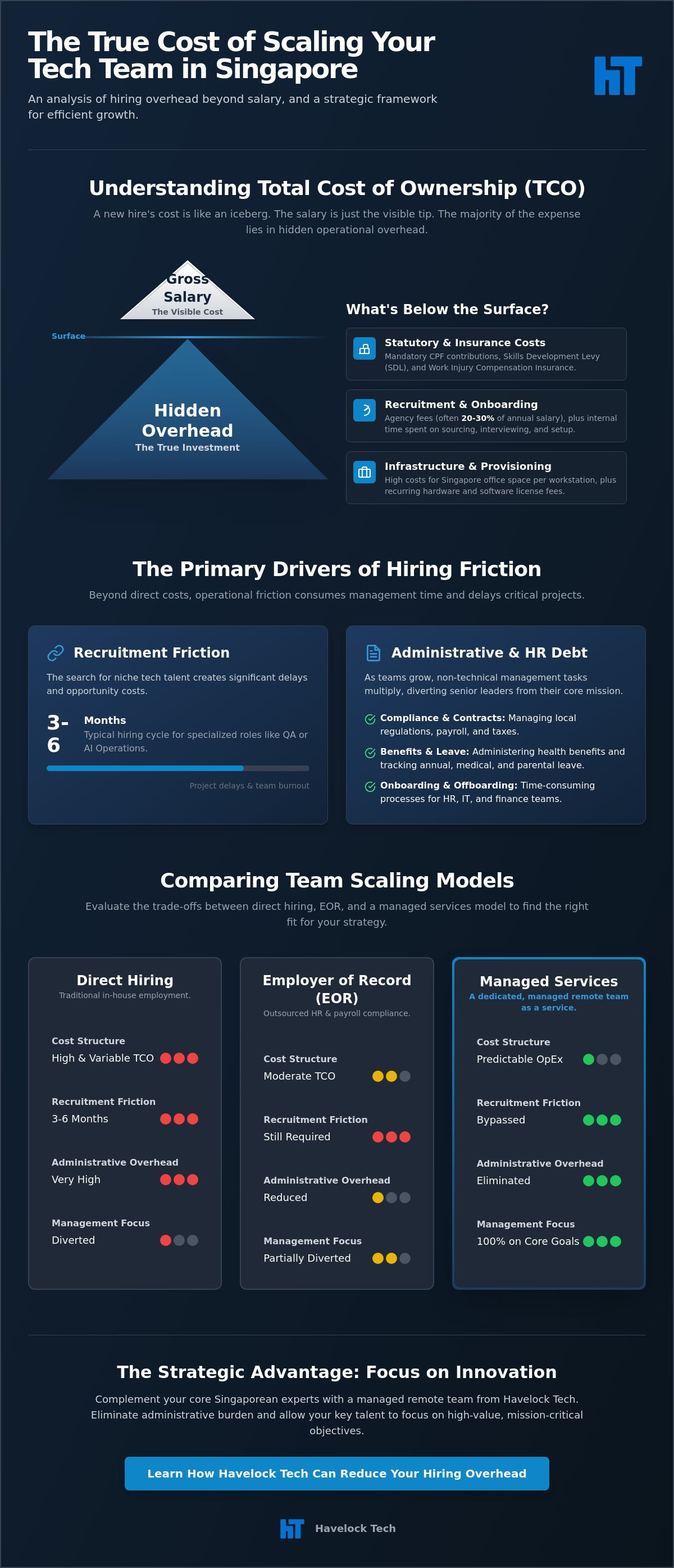
Evaluating Models: Direct Hiring vs. EOR vs. Managed Services
When looking to add capacity, Singaporean tech firms have several models to consider. Each offers a different balance of control, cost, and administrative responsibility. The right choice depends on the nature of the role and your company's strategic priorities.
- Direct Hiring: This traditional model offers the highest level of control and cultural integration. It is ideal for core, strategic roles that drive the company's vision. However, it also carries the maximum overhead, as the company is solely responsible for recruitment, payroll, compliance, infrastructure, and day-to-day management.
- Employer of Record (EOR): An EOR service acts as the legal employer for your staff, handling payroll, taxes, and statutory compliance. This model reduces your administrative burden but leaves the critical tasks of recruitment, onboarding, training, and performance management entirely in your hands.
- Managed Services: This model provides dedicated, pre-vetted talent along with a layer of built-in management and administrative support. It is designed to function as a seamless extension of your existing team, handling specific operational functions while you retain control over tasks and priorities. This approach is ideal for complementing your local team with support roles.
- Freelance Marketplaces: While offering the lowest initial cost, relying on freelancers for ongoing operational roles introduces significant risk related to quality, consistency, and availability. This model is better suited for short-term, discrete projects than for core business functions.
Platform vs. Managed Service: What’s the Difference?
It's important to distinguish between an EOR platform and a true managed service. While both facilitate remote work, their purpose and level of support are fundamentally different.
- Tools vs. Solutions: EOR platforms like Deel or Oyster are powerful software tools that streamline global payroll and compliance. They are a "self-service" solution where you find, vet, and manage the talent yourself.
- Full-Service Partnership: A managed service provider like Havelock Tech offers a "full-service" solution. We don't just process payroll; we source, vet, and manage the personnel, providing an operational framework that ensures quality and reliability.
- Reducing Management Burden: With a managed service, the provider handles performance oversight, administrative queries, and HR functions for the remote team. This significantly reduces the day-to-day management load on your internal leaders, freeing them to focus on strategic goals.
The GMT+8 Alignment Factor
For Singapore-based teams, operational synchronicity is non-negotiable. Real-time collaboration is essential for agile development, quality assurance, and support functions.
- The Need for Real-Time Work: Effective team integration depends on shared working hours. For daily stand-ups, sprint planning, and immediate issue resolution, having your entire team operating on the same GMT+8 clock is a critical advantage.
- Friction in Asynchronous Communication: Managing teams in Western timezones introduces significant communication delays. A simple query can take 24 hours to resolve, disrupting workflows and slowing down progress, particularly in fast-paced QA and AI support environments.
- Cultural and Geographic Proximity: Aligning with talent in nearby regions simplifies communication and fosters greater cultural understanding, leading to a more cohesive and integrated team dynamic.
Strategic Role Selection for Maximum Overhead Reduction
The most effective way to reduce administrative overhead is to strategically augment your team with managed support for roles that are operational, high-volume, and essential for execution but not part of your core intellectual property development. This approach allows you to scale capacity precisely where needed, freeing your Singapore-based experts to focus on innovation.
Scaling AI and Data Operations
Artificial intelligence and machine learning initiatives depend on vast quantities of accurately labeled and processed data. Building a large, local team for these tasks can create significant administrative and infrastructure overhead.
- The Overhead of Data Processing: Hiring, training, and managing a local team for high-volume data labeling, annotation, and verification is a resource-intensive process that can distract from the core work of your data science team.
- Managed Remote Team Efficiency: A managed remote team can handle these large-scale data operations efficiently. With established processes for quality control and oversight, they provide the clean, structured data your AI models need to perform, delivered as a predictable service. For more detail, read our guide on scaling with AI Operations Support Services .
QA and ERP Support Team Extensions
Quality Assurance and Enterprise Resource Planning (ERP) support are two areas where a team extension model provides immediate value by enhancing operational stability and freeing up senior technical staff.
- QA as a Strategic First Move: Augmenting your team with managed QA specialists is often the ideal first step in reducing engineering overhead. It allows you to expand testing capacity to cover more edge cases and regression scenarios without pulling your senior developers away from building new features.
- Maintaining ERP System Continuity: Your ERP system is the backbone of your business operations. A dedicated, remote ERP support team can manage user administration, troubleshooting, and system maintenance, ensuring business continuity. This allows your internal IT team to focus on strategic projects rather than routine support tickets. Learn more about this approach in our pragmatic strategy for ERP support team extensions .
- Targeted Administrative Relief: By offloading these well-defined functions, you achieve specific administrative relief. You reduce the management overhead associated with scaling these departments internally, allowing you to grow your operational capacity in a more controlled and cost-effective manner.
Implementing a Managed Remote Strategy with Havelock Tech
Havelock Tech provides a pragmatic path for Singaporean tech companies to scale their operational capacity. Our model is built around the philosophy of a "Team Extension," where we provide dedicated, managed talent that integrates seamlessly with your existing workflows, culture, and objectives. We handle the administrative complexities so you can focus on driving your business forward.
- The Havelock Tech Model: We operate on a simple, transparent monthly managed fee. This fee covers a dedicated remote professional who works exclusively for you, fully integrated into your team.
- Zero Recruitment Fees: Our model eliminates the large, upfront recruitment fees of 20-30% common with traditional agencies. This removes a major barrier to scaling and makes your budget more predictable.
- Built-in Oversight: Havelock Tech manages the back-end administration, including payroll, local compliance, and HR support for the remote team member. You maintain full control over their daily tasks and strategic priorities.
- The GMT+8 Guarantee: We guarantee that every member of your extended team works in the GMT+8 timezone, ensuring real-time collaboration and seamless integration with your Singapore office.
A Pragmatic Path to Scaling Tech Operations
Our goal is to provide stability and reliability, allowing established Singaporean firms to grow without the associated administrative friction.
- The "Team Extension" Philosophy: We provide more than just headcount; we provide integrated capacity. Our personnel become a functional part of your team, understanding your goals and contributing to your success, all without the administrative burden of direct employment.
- Comprehensive Administrative Handling: Havelock Tech manages all aspects of the remote team's employment, from contracts and payroll to local compliance in their home country, insulating you from cross-border HR complexities.
- Focus on Stability and Reliability: We specialize in providing long-term, stable team members for established businesses. Our focus is on building a reliable operational backbone that you can depend on as you scale.
Next Steps: From Audit to Integration
Adopting a managed remote strategy is a straightforward process focused on identifying needs and ensuring a smooth integration.
- Audit Your Overhead: Begin by conducting a simple internal audit. Identify the roles in your organization that are high-volume and operational, and calculate the time your senior leaders spend on administrative oversight versus strategic work.
- Define Role Requirements: Clearly define the tasks, responsibilities, and performance metrics for the roles you wish to augment. This ensures we can source and manage a remote team member who precisely fits your needs.
- Consult and Integrate: The final step is to engage with a managed service provider to align on processes and integration. A consultation can help map out how a remote team extension will fit within your current structure.
By strategically complementing your core Singaporean team with managed remote talent, you can scale your operational capacity efficiently, reduce administrative overhead, and empower your local experts to focus on what they do best: building the future of your business.
Ready to discuss your support needs?
Audit your hiring overhead with a Havelock Tech consultation and discover a more pragmatic path to scaling your team.
Prefer to talk first? Contact us.