

Why does your ERP backlog continue to grow even when you have an offshore support contract in place? You likely recognize that the primary friction isn't the software itself, but the disconnect between your Singapore business hours and distant support hubs. When critical tickets sit idle for eight hours, technical debt accumulates and operational agility stalls. With 47% of organizations already facing cost overruns during ERP implementation, the added expense of hiring local SAP, Oracle, or NetSuite experts often feels out of reach for growing teams.
Choosing managed erp support services shouldn't feel like a compromise between cost and quality. This guide demonstrates how to eliminate technical debt by integrating remote talent that operates as a direct extension of your team, synchronized to your specific timezone. You'll discover a pragmatic framework for scaling your operational capacity and reducing administrative burdens while ensuring your ERP environment remains stable and responsive to your business needs.
Key Takeaways
- Learn the critical distinction between basic software maintenance and a dedicated team extension model to prevent technical debt from stalling your operations.
- Understand how managed erp support services utilize GMT+8 synchronization to ensure real-time collaboration and eliminate the friction of timezone-delayed ticket resolution.
- Identify the hidden operational costs of delayed support during month-end closing and how to mitigate them through specialized platform proficiency.
- Discover the specific technical and compliance criteria required for ERP partners to effectively support Singaporean business standards.
- Evaluate a pragmatic approach to integrating remote talent into your existing workflows to reduce administrative oversight and focus on core objectives.
Defining Managed ERP Support Services for Modern Operations
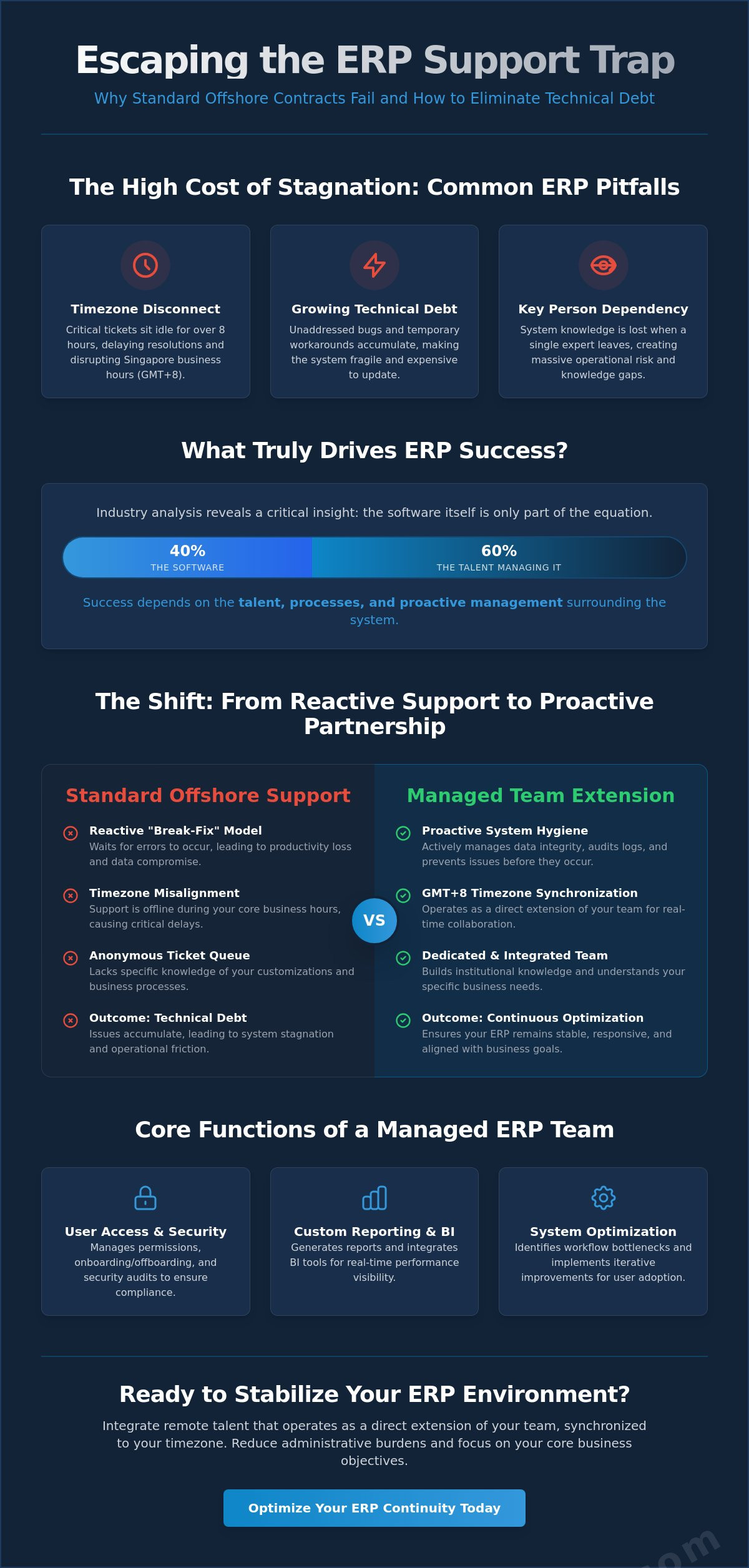
Most organizations view Enterprise Resource Planning (ERP) as a one-time software purchase or a static cloud subscription. In reality, the software is merely the engine; managed erp support services provide the engineering team that keeps it running at peak performance. Unlike standard software maintenance, which typically only covers patches and version updates from the vendor, managed support focuses on the daily operational health of your specific business processes. It's a dedicated team extension model designed to handle the complexities of your environment so your internal staff can focus on growth.
The traditional "break-fix" model is obsolete because it's fundamentally reactive. If you wait for a system error to occur before seeking help, you've already lost productivity and potentially compromised your data. Modern enterprise resource planning requires proactive hygiene. This involves managing data integrity, clearing stuck transactional queues, and auditing system logs before they lead to a crash. It's about maintaining a clean digital environment where your data remains a reliable asset rather than a liability that requires constant firefighting.
The Shift from Software-Centric to Talent-Centric Support
Industry experience suggests that having the right software only accounts for about 40% of an ERP's success. The remaining 60% depends entirely on the talent managing the system. You need a balanced mix of technical experts who understand the underlying code and functional experts who understand how a Singaporean finance or logistics team actually uses the interface. Managed services provide a level of continuity that individual contractors can't match. If a contractor leaves, their specific knowledge of your customizations goes with them. A managed team ensures that documented processes and institutional knowledge stay within your reach, providing stability through any internal personnel changes.
Core Functions of a Managed ERP Support Team
A dedicated support team handles the administrative friction that slows down your internal operations. Their role includes several critical tasks that keep the system aligned with your business goals:
- User access and security: Managing permissions, handling onboarding/offboarding, and performing regular security audits to ensure compliance with local data regulations.
- Custom reporting and BI: Generating specific reports and integrating business intelligence tools so leadership has real-time visibility into performance.
- System optimization: Identifying bottlenecks in workflows and implementing small, iterative improvements that enhance user adoption.
Ultimately, ERP support is a continuous operational heartbeat that sustains your business, rather than a temporary project with a defined end date.
The High Cost of ERP Stagnation: Why Standard Support Fails
Many organizations focus heavily on the initial implementation cost but overlook the ongoing total cost of ownership (TCO). This oversight often leads to the "Technical Debt Trap." In this scenario, unaddressed bugs and temporary workarounds accumulate over time, eventually making the system too fragile to update. When your ERP stagnates, the hidden costs manifest during critical business cycles. A delayed support ticket during month-end closing doesn't just frustrate the finance team; it delays financial reporting and impacts cash flow visibility. When reconciliations fail because of a database lock or a custom script error, the resulting delay can hold up board reports and tax filings. Transitioning to managed erp support services allows you to move away from this reactive cycle and protect your governance standards.
The Singapore Tech Talent Gap
Finding and retaining local ERP specialists in Singapore has become a significant operational hurdle. The high demand for SAP, Oracle, and NetSuite experts has driven salaries upward, making it difficult for many firms to maintain a full internal team. This creates "Key Person Dependency," where the entire system's health rests on one or two individuals. If these employees leave, they take years of custom configuration knowledge with them. Specialized managed erp support services mitigate this risk by providing a team-based approach to system management. This structure ensures that your operational knowledge is documented and shared, preventing a single resignation from paralyzing your business operations.
Communication Friction in Traditional Outsourcing
Traditional offshore models often fail Singaporean firms due to the "Midnight Ticket" problem. If a warehouse system fails at 10:00 AM SGT, a support team in a Western timezone won't even see the ticket for another eight hours. These delays ripple through the supply chain, leading to inaccurate inventory data and missed delivery windows. Generic global call centers also struggle with the specific regulatory and business standards required in the local market. When communication breaks down, technical issues that should take minutes to solve often stretch into days. Firms seeking to avoid these pitfalls often find that integrating dedicated remote talent synchronized to their local hours provides a more reliable operational backbone.
The Managed Team Extension Model: A Pragmatic Alternative
Team extension differs from traditional project outsourcing by focusing on long-term integration rather than a fixed deliverable. In a project-based model, the relationship typically ends once a specific module is "live," leaving your internal staff to handle the inevitable post-launch bugs. In contrast, managed erp support services provide a continuous resource that grows alongside your business requirements. This model allows you to retain full strategic control over your ERP roadmap while delegating the technical execution to a dedicated team. You decide which tickets take priority and which workflows require optimization, ensuring the system remains aligned with your specific commercial objectives.
One of the most immediate benefits is the significant reduction of administrative friction. When you scale an internal team in Singapore, you're responsible for recruitment, payroll, CPF contributions, and ongoing HR compliance. A managed service provider handles these logistical complexities on your behalf. This capability provides operational relief, allowing your leadership team to focus on high-level strategy rather than the mechanics of human resource management. It's a low-risk way to augment your capabilities without increasing your head-count overhead or administrative burden.
Timezone Alignment: The GMT+8 Advantage
Same-day resolution is only possible when your support team operates during your business hours. When a technical glitch occurs during the Singapore morning rush, you need an immediate response to prevent warehouse or finance delays. Working with personnel in the GMT+8 timezone facilitates "Side-by-Side" digital collaboration, where your local staff and the remote team communicate in real-time through shared channels. This geographical synchronization ensures that a request made at 9:00 AM is addressed by 9:05 AM. GMT+8 alignment eliminates the 12-hour feedback loop that often paralyzes decision-making in traditional offshore models.
Managed Services vs. Freelancers vs. Local Hires
While local hires offer the most direct oversight, the cost of senior ERP consultants in Singapore can be prohibitive for many mid-sized firms. Local specialists often command premium salaries and are frequently headhunted, leading to high turnover. Freelancers might seem like a cost-effective alternative, but they often lack the long-term accountability required for ERP maintenance. They may move on to other projects, leaving you with unmaintained custom code and no documentation. Managed talent providers act as a "Safe Pair of Hands," offering the scalability of a freelancer with the professional stability of a corporate hire. This middle-ground approach ensures that your ERP support is both financially sustainable and operationally reliable over the long term.
Critical Criteria for Evaluating ERP Support Partners
Selecting the right partner for managed erp support services requires a shift in focus from software features to personnel capabilities. A reliable partner doesn't just provide a helpdesk; they provide a structured methodology for talent selection and performance management. You should demand transparency in how specialists are vetted and how their performance is measured against your specific KPIs. Scalability is equally vital. A partner that can only provide a single freelancer creates the same "Key Person Dependency" risk mentioned earlier. Instead, look for a provider capable of scaling from one dedicated specialist to a multi-disciplinary team as your operational volume increases.
Your evaluation should also prioritize a proven track record in national compliance. ERP systems in Singapore must handle specific local requirements, such as GST reporting and IRAS-compliant accounting standards. A partner who understands these nuances can ensure your system remains a tool for compliance rather than a source of regulatory risk. Transparency in management fees is also essential. Avoid providers with opaque pricing structures that hide administrative costs; instead, opt for a model where you know exactly what you are paying for the talent and the management layer that supports them.
Assessing Technical and Functional Depth
Vetting remote talent involves more than checking a resume. You need to verify specific module expertise, such as FICO (Finance and Controlling), MM (Materials Management), or SD (Sales and Distribution). A "Full-Stack" support capability is preferred, meaning the team can handle both technical database issues and functional user training. Ongoing training and certification in platforms like SAP S/4HANA or Oracle NetSuite ensure that your support team stays current with the latest security patches and feature releases. If you are ready to stabilize your operations, you can explore our ERP support talent options to find the right fit for your environment.
Governance and Security Standards
Data privacy is a non-negotiable aspect of remote ERP access. Your partner must adhere to strict protocols that align with Singapore's Personal Data Protection Act (PDPA). This includes secure VPN tunnels, multi-factor authentication, and role-based access controls that limit what remote staff can see. Structured reporting and oversight are the final pieces of the governance puzzle. You should receive regular updates on ticket resolution times, system uptime, and any proactive maintenance performed. This level of transparency ensures that you remain in control of your digital assets while delegating the heavy lifting of execution to trusted experts.
Optimising ERP Continuity with Havelock Tech’s Managed Talent
Havelock Tech provides a pragmatic solution for Singaporean firms facing the dual challenges of high local talent costs and the operational friction of traditional offshore models. By offering dedicated ERP support talent, we ensure your system remains stable while your organization scales. Our managed erp support services are designed to function as a seamless extension of your existing team, removing the administrative burden of recruitment and payroll management. This approach allows your leadership to view the ERP environment as a catalyst for business growth rather than a recurring cost centre that drains internal resources.
Integrating a remote specialist shouldn't disrupt your established workflows. We handle the complexities of back-end administration and HR compliance, providing a safe pair of hands for your technical oversight. This operational relief enables your internal IT managers to shift their focus from ticket management to strategic digital transformation. By delegating the execution of routine maintenance and custom reporting to our specialists, you gain the capacity to leverage your data for better decision-making and increased market responsiveness.
Our Integration Process: From Onboarding to Execution
Success begins with a precise match between our talent and your specific ERP ecosystem. We vet candidates not only for technical proficiency in platforms like SAP or Oracle but also for their ability to align with your company culture and communication style. During the first 30 days, we focus on establishing clear communication channels and defining priority queues. This initial phase ensures that the remote team understands your business-critical processes and specific month-end requirements. Continuous management oversight remains a core component of our model, ensuring that every specialist meets our standards for quality and reliability.
Why National Tech Teams Choose Havelock Tech
Singaporean tech leaders value our strict commitment to GMT+8 alignment. This synchronization ensures that your support team is active and responsive when your business is most vulnerable to disruptions. Our clients report measurable improvements in system uptime and a significant reduction in technical debt as long-standing backlogs are finally cleared. By maintaining a consistent operational flow, we help you avoid the supply chain delays and financial reporting bottlenecks that often plague less integrated support models. If you're ready to secure your system's future, you can Schedule an ERP Support Consultation with Havelock Tech today.
Future-Proofing Your ERP Environment Through Strategic Integration
Maintaining a robust ERP system requires more than just software updates; it demands a stable and responsive talent layer. You've seen how timezone alignment and the team extension model can eliminate the technical debt that often paralyzes operational growth. By transitioning from a reactive "break-fix" approach to a proactive managed model, your organization can ensure long-term system hygiene and data integrity. This shift allows your internal leadership to focus on high-level strategy while technical execution remains in expert hands.
Investing in managed erp support services provides the operational stability needed to scale without the prohibitive costs of local hiring. Havelock Tech offers specialized GMT+8 timezone alignment to ensure your support team is active when you need them most. We handle the full administrative management of your remote staff, including payroll and compliance, to reduce your internal overhead. You'll work with dedicated personnel who understand your specific workflows, rather than a generic ticket queue. This ensures that your system remains a high-utility asset that evolves with your business needs.
Increase your ERP execution capacity with Havelock Tech and transform your enterprise software into a reliable engine for success. We're ready to help you build a more resilient and predictable operational backbone.
Frequently Asked Questions
What is the difference between ERP maintenance and managed ERP support?
Software maintenance is typically provided by the vendor to cover system patches, version updates, and core bug fixes. In contrast, managed erp support services focus on your daily business operations, such as resolving transactional errors, managing user permissions, and generating custom reports. It ensures the system remains aligned with your specific business workflows rather than just keeping the software version current.
How does GMT+8 timezone alignment improve ERP support efficiency?
GMT+8 alignment ensures that your support team is active during your core Singapore business hours. This allows for immediate ticket resolution when technical issues arise during the morning rush or critical end-of-day processing. It removes the operational friction caused by waiting for Western-timezone support hubs to begin their day, ensuring your supply chain and finance functions remain uninterrupted.
Can managed ERP support teams work with custom-built legacy systems?
Yes, managed teams can support custom-built legacy environments provided there is a structured knowledge transfer process. Specialists document existing custom code and workarounds to ensure continuity and system stability. This approach reduces the risk of "Key Person Dependency" by spreading technical knowledge across a managed team rather than leaving it with a single individual who might leave the company.
How do managed services handle the security of our sensitive financial data?
Security is managed through strict access protocols, including encrypted VPN tunnels and multi-factor authentication. All remote talent follows data privacy standards that align with Singapore's Personal Data Protection Act (PDPA). Role-based access ensures that specialists only see the specific data fields required to perform their technical or functional tasks, protecting your sensitive financial information.
What are the typical cost savings when moving from local ERP hiring to managed remote talent?
Moving to managed remote talent reduces the total cost of ownership by eliminating local recruitment fees, CPF contributions, and office overhead in Singapore. Businesses often find they can access senior-level expertise for a lower total investment than hiring a junior local specialist. This model provides a predictable monthly management fee instead of the fluctuating administrative costs associated with local head-count.
How quickly can a managed ERP support team be integrated into our workflow?
Integration typically occurs within a 30-day window. The first two weeks focus on system access and knowledge transfer, while the remaining time is spent establishing communication channels and priority queues. This structured onboarding ensures that the managed erp support services become a functional extension of your team without disrupting your ongoing business operations.
Does Havelock Tech provide support for specific ERP modules like SAP FICO or Oracle SCM?
Yes, Havelock Tech matches talent to your specific ERP module requirements, including SAP FICO, Oracle SCM, and Microsoft Dynamics modules. We vet specialists for their functional depth in areas like financial controlling or supply chain management. This ensures your support team understands the business logic behind the data they are managing, leading to more accurate ticket resolution.
Who maintains control over the daily priorities of the remote ERP staff?
You retain full control over the strategic priorities and daily task lists of the remote staff. The managed model is designed as a team extension where you direct the "what" and "when," while the provider handles the "how" and the administrative oversight. This ensures that your ERP roadmap remains firmly under your internal leadership's guidance while execution is handled by dedicated experts.