

If you could increase your team’s technical output without increasing your administrative workload, would you still prioritize traditional local recruitment? Most engineering managers agree that the complexity of hiring, payroll, and regional compliance has become a significant bottleneck to growth. The effort required to manage these logistics often distracts from core product objectives. Integrating managed services for tech teams into your operational strategy offers a reliable way to bypass these hurdles while maintaining high quality standards.
This guide explains how modern managed services have evolved beyond basic IT support into integrated talent solutions. You'll discover how to scale your capacity using a managed engagement model that handles the backend complexities of remote operations. We will examine the shift toward AI-driven service delivery and provide a roadmap for reducing administrative overhead while ensuring your technical standards remain uncompromised. By the end of this article, you'll understand how to position your organization for steady, low-risk growth in a global market valued at over $437 billion in 2026.
Key Takeaways
- Understand how modern managed services for tech teams have transitioned from basic infrastructure maintenance to proactive talent management models.
- Learn how to integrate remote technical talent into your existing workflow while retaining full control over project priorities and quality standards.
- Identify the specific operational functions, such as AI operations and data processing, that are best suited for managed support to maximize efficiency.
- Discover why a managed personnel model offers greater stability and lower risk than traditional freelancing or unmanaged offshore outsourcing.
- Explore how delegating administrative burdens like payroll and compliance allows your internal leadership to focus exclusively on technical execution.
What are Managed Services for Tech Teams in 2026?
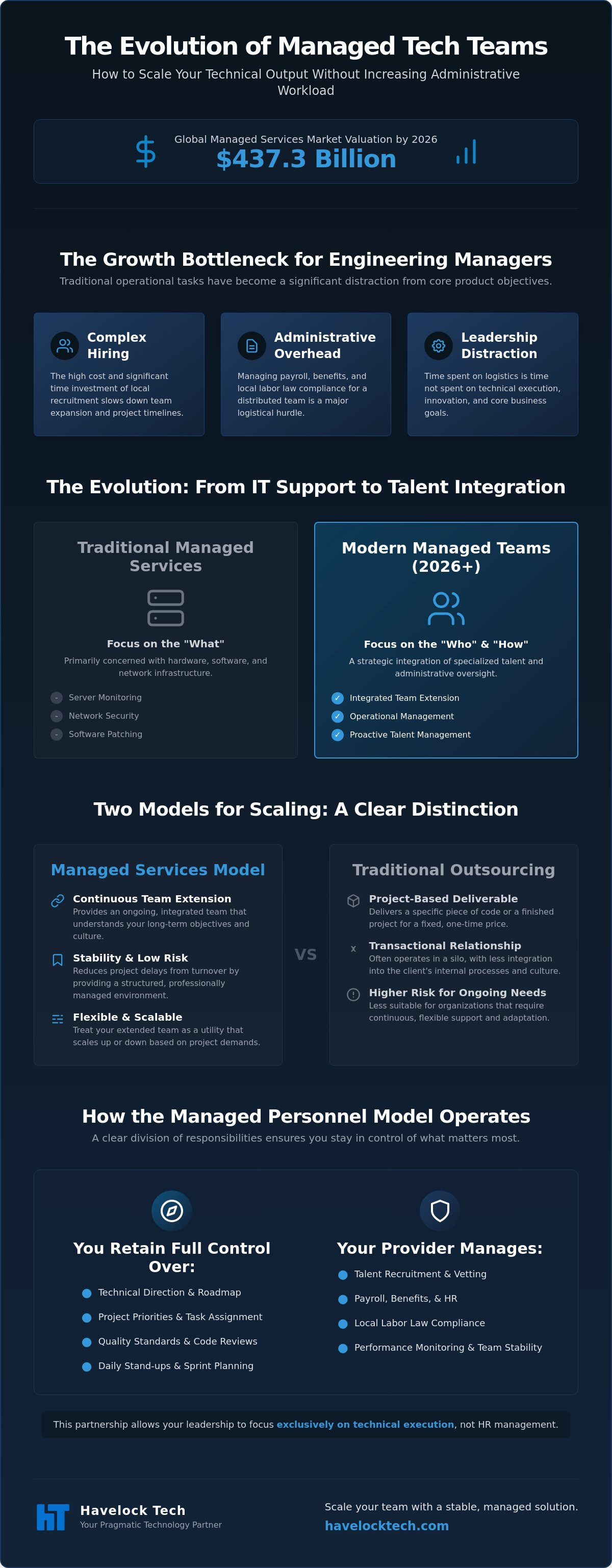
Traditional managed services often focus on keeping servers running or monitoring network security. In 2026, the definition has shifted. Modern managed services for tech teams now represent a strategic integration of specialized talent and administrative oversight. It's no longer just about the "what," such as hardware or software uptime. It's about the "who" and the "how." This model provides the skilled personnel and the operational management framework required to execute ongoing technical work without the friction of traditional hiring.
Traditional outsourcing often delivers a specific project or a finished piece of code for a fixed price. In contrast, a managed service provides a continuous team extension. This distinction is vital for organizations that need flexible, ongoing support rather than one-off deliverables. It allows for a more integrated approach where the managed team understands your internal culture and long-term technical objectives. Technology infrastructure has become more resilient and cloud-native, which reduces the need for manual troubleshooting. The primary bottleneck for growth is now the difficulty of sourcing and managing personnel. A managed service provider acts as an operational backbone, allowing your internal leadership to direct technical priorities while the provider handles the logistics of team stability.
The Evolution of the Managed Service Model
The model has moved from simple remote server monitoring to sophisticated team extensions. In the past, a provider might have managed your firewall or updated your software patches. Today, they provide entire functional units that operate as a seamless part of your organization. This evolution responds to the increasing complexity of global business. With the global managed services market valued at approximately $437.3 billion in 2026, tech leaders are looking for more than technical assistance. They require operational stability. Delegating the administrative burden allows companies to scale their output without the friction of expanding internal HR or legal departments. Modern teams prioritize this stability because it reduces the risk of project delays caused by sudden turnover or recruitment gaps.
Key Components of a Managed Tech Service
A comprehensive approach to managed services for tech teams includes several critical layers of support designed to reduce executive stress:
- Recruitment and Vetting: The provider identifies and qualifies technical talent based on your specific requirements, which eliminates the high cost and time of local recruitment.
- Administrative Handling: The provider manages payroll, benefits, and local labor law compliance, which removes the legal risks associated with cross-border operations.
- Management Oversight: A dedicated manager ensures that the remote personnel remain productive and aligned with your goals, which maintains high quality standards without requiring your constant intervention.
These components work together to create a low-risk environment for scaling. You retain control over the technical direction and priorities, while the provider ensures the team is present, paid, and performing. This division of labor allows you to treat your extended team as a utility that scales up or down as your project demands change. It replaces the high-risk "gig economy" approach with a structured, professional environment that respects your existing expertise.
How the Managed Personnel Model Operates
Operational integration begins with a clear division of responsibilities. Managed personnel don't operate in a vacuum; they become a functional part of your existing ecosystem. This ensures that managed services for tech teams provide immediate utility without the friction of a long onboarding period. The workflow is designed to mirror your internal processes, allowing for a seamless extension of your capacity while the provider handles the logistical complexities in the background.
Integration and Daily Management
Managed staff members participate directly in your daily stand-ups and sprint planning sessions. They use your preferred communication tools and project management platforms, which ensures that everyone remains aligned on technical goals. The provider monitors performance and attendance behind the scenes, addressing any personnel issues before they impact your delivery schedule. The client retains exclusive authority over technical roadmaps and task priorities, whereas the provider assumes full accountability for the administrative oversight and operational reliability of the team members. This structure allows your leads to focus on execution rather than HR management.
The GMT+8 Timezone Advantage
For Singapore-based operations, timezone alignment is a critical factor for success. Traditional offshore models often suffer from a "lag" where feedback loops take twenty-four hours to complete. By utilizing managed services for tech teams that operate within the GMT+8 timezone, you enable real-time collaboration. This synchronization is particularly vital for high-velocity tasks such as QA testing and data processing. Teams can conduct live code reviews and address urgent bugs during standard business hours, which significantly accelerates the development lifecycle. When your remote talent is online at the same time as your local team, the distinction between "in-house" and "remote" begins to disappear. Exploring a managed engagement model that prioritizes this geographic alignment reduces the friction of cross-border coordination.
Data security and technical compliance are also central to the managed model. The provider ensures that all personnel adhere to your specific security protocols and data handling requirements. This includes maintaining secure workstations and following established compliance standards, which is essential for teams handling sensitive information or operating in regulated industries. By centralizing these requirements under a managed framework, you reduce the risk of security gaps that often occur with unmanaged freelancers or fragmented gig-economy workers. The result is a stable, compliant, and highly responsive technical unit that scales alongside your primary objectives.
Managed Services vs. Traditional Outsourcing
Choosing the right model for scaling your technical capacity requires an analysis of total operational costs and long-term stability. While freelance marketplaces and direct recruitment are common alternatives, they often introduce the administrative friction that managed services for tech teams are designed to eliminate. The primary difference lies in who carries the burden of oversight and the risk of turnover. A managed service is a commitment to an operational outcome, whereas other models often leave the client responsible for the logistical mechanics of the team.
Managed Services vs. Freelancing
Freelance platforms seem cost-effective on the surface, but they carry significant hidden management costs. When you hire an unmanaged freelancer, you assume full responsibility for vetting their skills, securing their workstations, and monitoring their daily productivity. Reliability is a constant concern; if a freelancer suddenly leaves a project, your progress stops immediately. Managed providers mitigate this replacement risk automatically. They maintain a pipeline of qualified talent and handle the transition if a team member needs to be replaced, which ensures that your project timelines remain unaffected by individual personnel changes. This continuity provides a level of security that the gig economy cannot match.
Managed Services vs. Direct Hiring
Directly hiring international staff creates a permanent increase in fixed costs and introduces complex legal requirements. Navigating foreign labor laws, managing international payroll, and providing localized benefits packages place a heavy burden on your internal HR and finance departments. While Employer of Record (EOR) platforms can handle the legal paperwork, they do not provide technical oversight or performance management. A managed service operates as a flexible operational expense rather than a permanent headcount increase. You receive the dedicated capacity of a full-time employee without the long-term legal liabilities or the administrative "heavy lifting" associated with traditional employment.
Scalability is where the managed model provides the most significant advantage. Internal recruitment for specialized technical roles frequently takes several months to finalize. In contrast, a managed service can typically deploy vetted personnel in a matter of weeks. This speed allows you to respond to shifting market demands or sudden project spikes without overextending your internal resources. By shifting the focus from simple hourly rates to the total cost of management, it becomes clear that managed services for tech teams offer a more predictable and stable path for growth. You gain a reliable extension of your organization that scales according to your needs, supported by a partner that handles the complexities of back-end administration.
Identifying Functions for Managed Support
Delegating the right functions is essential for maintaining a high-velocity development environment. Not every technical task requires the high cost of a senior local hire. Organizations often find the greatest value in using managed services for tech teams for high-volume, repetitive, or maintenance-heavy operations. This strategic division of labor ensures that your most expensive internal resources remain focused on high-value product innovation and architectural decisions. By identifying which tasks are "context" rather than "core," you can scale your output without diluting your focus.
AI Operations and Data Processing
AI data training and labeling are ideally suited for managed remote teams due to their high volume and the need for consistent, disciplined execution. As AI-driven operations become a standard trend in 2026, the demand for clean, structured data has increased. Scaling these operations internally often overwhelms local leads with administrative oversight and quality control. A managed service provider handles the recruitment and daily management of these specialists, ensuring that quality benchmarks are met through rigorous internal auditing. This allows your data scientists to focus on model refinement rather than data cleaning logistics.
Quality Assurance and System Support
Integrating remote QA talent into your software development lifecycle provides a layer of protection against production errors. Managed personnel can handle manual regression testing, bug verification, and cross-browser checks that often slow down your primary developers. By maintaining a consistent cadence of regression testing and bug verification, managed QA teams prevent technical debt from accumulating and compromising long-term platform stability.
Similarly, ERP support requires dedicated attention to ensure business continuity. Whether you are managing complex financial modules or supply chain integrations, having specialized personnel available during your business hours is critical. Managed support teams provide the necessary oversight to handle intelligent ticketing and automated issue resolution, which industry data suggests can reduce support ticket volume by 40 to 60 percent. This predictable support structure ensures that your core systems remain operational while your internal team builds the future of your product. If you are ready to scale your operational output, you can hire managed QA and data talent to bridge the capacity gap.
Scaling with Havelock Tech: A Pragmatic Partnership
Havelock Tech provides a grounded, operationally focused approach to managed services for tech teams. We act as a disciplined facilitator for organizations that need to scale their capacity without increasing their administrative burden. Our model is built on the principle of managed engagement, where we handle the logistical complexities of remote operations so your leadership can remain focused on technical execution. We don't just provide personnel; we provide a stable operational backbone that respects your existing expertise and integrates seamlessly with your current workflows.
Our service handles the administrative "heavy lifting" that often stalls growth. This includes managing international contracts, executing payroll, and ensuring compliance with local labor laws. By centralizing these functions, we remove the friction typically associated with cross-border team expansion. You retain full control over project priorities and technical standards, while we assume accountability for the personnel management and administrative oversight that keeps the team productive.
Our Operational Framework
Our framework prioritizes geographic and temporal alignment to ensure real-time collaboration. By focusing on GMT+8 alignment, we ensure that our remote talent is available during your standard Singapore business hours. This eliminates the communication delays found in traditional offshore models and allows for immediate feedback during critical development cycles. We simplify your financial planning through a predictable monthly managed service fee. This transparent pricing model replaces the volatile costs of recruitment and the legal complexities of foreign employment with a single, manageable operational expense.
The process of matching dedicated remote personnel to your specific needs is methodical and precise. We focus on specialized roles that provide the highest utility for modern tech operations:
- AI Operations Support: Managed personnel for high-volume data training and model maintenance.
- Data Processing Services: Reliable talent for structured data entry and technical processing.
- Quality Assurance (QA) Talent: Integrated testers who prevent technical debt and ensure platform stability.
- ERP Support: Dedicated specialists who maintain business continuity for core enterprise systems.
Getting Started with Team Extension
The roadmap to scaling starts with a clear identification of your current capacity gaps. Once your needs are defined, we match vetted technical talent to your specific requirements, ensuring they possess both the skills and the professional discipline required for your environment. During the onboarding process, we facilitate the integration of these members into your daily sprints and stand-ups. This deliberate approach ensures that your company culture and quality standards remain intact even as your output increases. You gain a reliable, "safe pair of hands" that manages the back-end complexities, allowing your core team to innovate. If you are ready to expand your capacity without the administrative friction, you can scale your tech team with Havelock Tech today.
Strategic Scaling for Technical Stability
Scaling a technical organization requires a shift from fragmented hiring to structured team extensions. By delegating administrative oversight and focusing on high-impact functions like AI Ops and QA, you protect your core engineers from operational burnout. Implementing managed services for tech teams ensures that your capacity grows in lockstep with your ambitions. It's a reliable way to maintain momentum without the friction of local recruitment cycles or the instability of the gig economy.
Havelock Tech provides this stability through GMT+8 timezone alignment and full administrative and payroll management. You gain access to specialized talent for AI Ops, QA, and ERP without the logistical friction of traditional recruitment. This pragmatic model allows you to maintain high standards while focusing on your primary product objectives. Your technical roadmap deserves a partner that handles the mechanics of execution with professional discipline and logistical competence.
Scale your tech operations with managed remote talent and build a resilient foundation for your growth strategy today. Your team can focus on innovation while we ensure the operational backbone remains secure and reliable.
Frequently Asked Questions
What exactly is included in a managed service fee for tech teams?
A managed service fee includes the full suite of operational support required to maintain a team member. This encompasses the recruitment and vetting process, localized payroll administration, and benefits management. It also covers the cost of management oversight and the logistical infrastructure needed for remote work. By consolidating these costs into a single monthly fee, you achieve greater financial predictability and eliminate the hidden expenses of internal HR handling.
How does a managed service provider ensure the quality of remote talent?
Providers ensure quality through a multi-stage vetting process that includes technical assessments and professional background checks. Once a team member is onboarded, ongoing performance monitoring and regular internal audits maintain high standards of output. This disciplined oversight ensures that the personnel remain productive and aligned with your specific technical requirements. The provider acts as an expert facilitator, addressing any performance gaps before they impact your delivery schedule.
Will I still have direct contact with the remote personnel in a managed model?
Yes, you maintain direct daily contact with the remote personnel for all technical priorities and task assignments. They function as a seamless extension of your team, participating in your Slack channels, stand-ups, and sprint planning sessions. While the provider handles the administrative and management logistics, you retain full authority over the technical roadmap. This ensures that the work remains synchronized with your internal culture and project goals.
How do managed services handle international payroll and compliance for Singapore companies?
The provider assumes full responsibility for the legal and financial mechanics of employment in the remote region. This includes managing local tax contributions, social security benefits, and compliance with regional labor regulations. For Singapore-based companies, this removes the need to establish foreign entities or navigate complex international employment laws. You receive the technical output while we handle the administrative heavy lifting behind the scenes.
What is the difference between a managed service and a recruitment agency?
Recruitment agencies focus exclusively on the initial hire and charge a one-time placement fee. In contrast, managed services for tech teams provide an ongoing operational partnership that includes performance monitoring and administrative support. While an agency ends its involvement after the contract is signed, a managed service provider remains accountable for the stability and productivity of the personnel throughout their entire tenure with your organization.
Can managed services help with specialized roles like AI operations or QA engineers?
Yes, managed services are particularly effective for specialized operational roles such as AI operations and Quality Assurance. We provide vetted talent specifically trained for data processing, AI model maintenance, and manual or automated testing cycles. These roles are essential for maintaining platform stability and scaling data-heavy projects. By delegating these specialized functions, you allow your core developers to focus on high-level architectural innovation and product design.
How quickly can a managed tech service scale our team capacity?
Managed services can typically deploy vetted personnel in a matter of weeks, which is significantly faster than the months often required for local recruitment. The provider maintains an active pipeline of qualified technical talent, allowing for rapid response to new project demands. This speed allows your organization to scale up or down based on immediate operational needs without the risk of long-term legal liabilities. It provides a flexible way to bridge capacity gaps as they arise.
Is my data secure when working with a managed remote team?
Data security is maintained through the strict application of your existing internal protocols and secure remote environments. Personnel operate within a managed framework that includes hardware security, encrypted communications, and adherence to regional data privacy regulations. This structured approach reduces the security vulnerabilities often associated with unmanaged freelancers. managed services for tech teams ensure that all personnel understand and follow your specific compliance requirements to protect sensitive intellectual property.