

What is Remote SAP Support and Why Does it Matter Now?
As Singapore's adoption of SAP S/4HANA continues to accelerate, the demand for skilled support has reached a critical juncture. For many tech leaders, the term "remote SAP support" might conjure images of offshore helpdesks and anonymous ticketing systems. However, a more strategic model has emerged: managed remote SAP support, which functions as a direct extension of your in-house team. This isn't about outsourcing problems; it's about integrating skilled personnel to prevent them.
This model stands in contrast to official SAP Enterprise Support, which is invaluable for product-level issues and core software bugs but isn't designed for day-to-day operational assistance, custom development, or functional configuration. The modern approach addresses the specific operational realities facing Singaporean companies, driven by a confluence of powerful factors:
- Cost Reduction: Accessing a global talent pool mitigates the high cost of local SAP consultants in Singapore, allowing for more extensive support within the same budget.
- Talent Scarcity: Finding experienced local specialists in niche areas like BASIS administration or advanced ABAP development is increasingly difficult. A remote model opens up a wider search area.
- 24/7 System Continuity: While not the primary focus of a same-timezone model, the infrastructure built for remote support enhances overall system resilience and disaster recovery capabilities.
The strategic shift toward hybrid and remote ERP management is no longer a trend but an operational necessity for businesses aiming for both efficiency and stability.
The Evolution of ERP Support Models
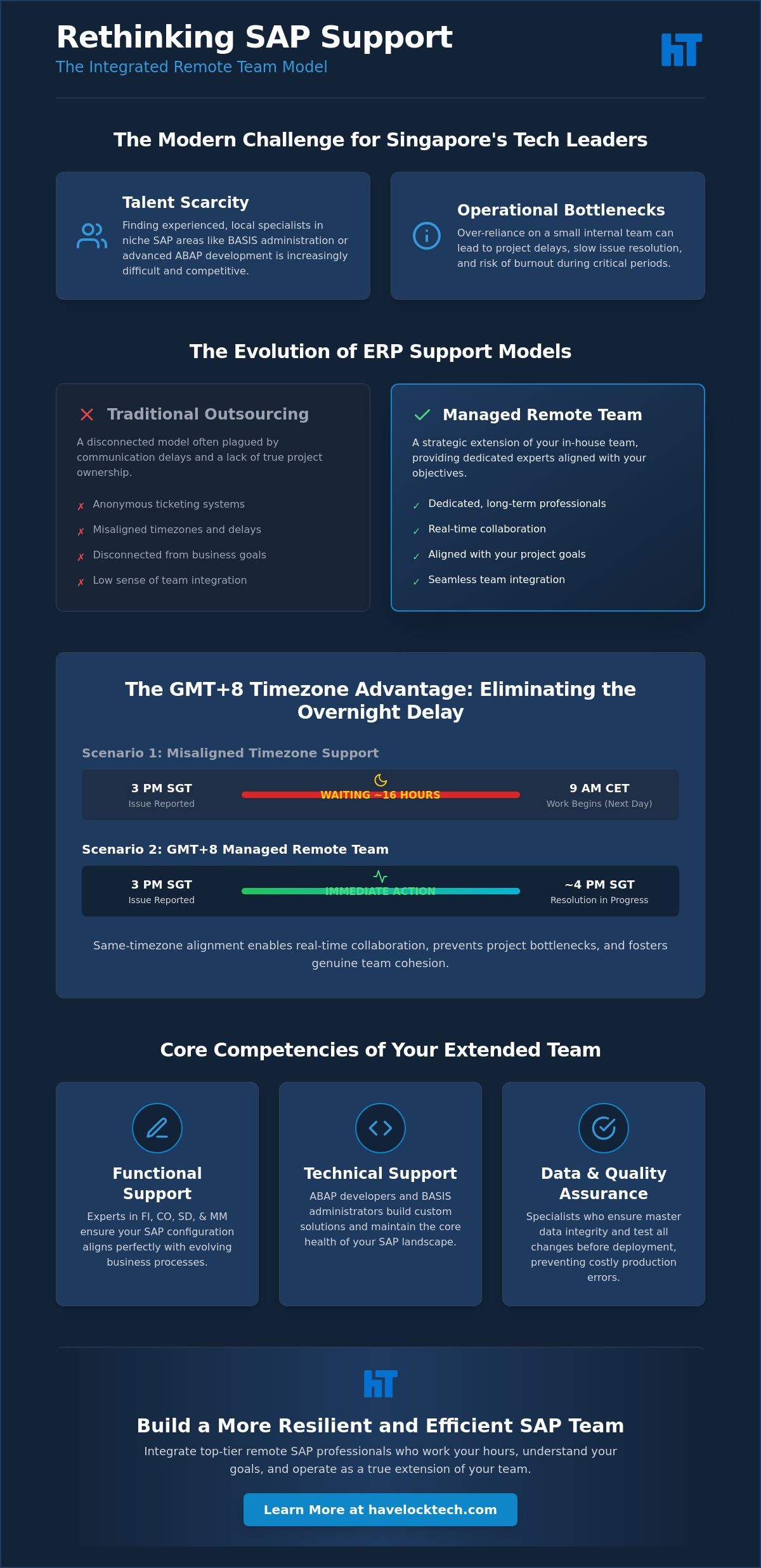
The journey of ERP support has moved from exclusively on-site consultants to large, often impersonal, global delivery centres. While these centres offered cost benefits, they frequently introduced new problems, such as communication delays, cultural misalignment, and a frustrating lack of project ownership. Traditional outsourcing often fails because the support team remains disconnected from the client's core business objectives, operating as a separate entity rather than an integrated part of the whole.
In response, the "Managed Remote" model has gained prominence among tech-heavy firms in Singapore. This model provides dedicated, long-term remote professionals who are managed administratively by a partner but directed operationally by you, the client. They become part of your team, participating in your daily stand-ups and aligning with your project goals, solving the integration problem that plagues traditional outsourcing.
Critical SAP Modules Requiring Constant Support
A robust SAP environment is a complex ecosystem that requires continuous maintenance and expert oversight. Effective remote support covers the full spectrum of needs, from high-level functional guidance to deep technical administration.
- Functional Support: This involves specialists in core SAP modules like Finance (FI), Controlling (CO), Sales and Distribution (SD), and Materials Management (MM) across platforms such as SAP S/4HANA, ECC, and Business One. They ensure the system configuration aligns with evolving business processes.
- Technical Support: This is the domain of ABAP developers who create custom reports, interfaces, and enhancements, and BASIS administrators who manage the underlying health of the SAP landscape, including performance tuning, transport management, and security.
- Data Processing and QA: Often overlooked, these roles are crucial for ERP integrity. Data processing specialists ensure master data quality, while QA analysts test changes and new developments before they are moved to the production environment, preventing costly errors.
The Strategic Advantage of GMT+8 Timezone Alignment
For Singaporean companies, timezone alignment is the secret sauce that transforms remote support from a potential liability into a powerful strategic asset. While cost savings are a significant driver, the operational efficiency gained from having a remote team working in the same GMT+8 timezone cannot be overstated. This synchronicity eliminates the "communication tax"—the inherent delay and friction that comes from managing teams across different continents.
The impact is most profound when dealing with urgent issues. A "Very High" priority case logged at 3 PM Singapore time can be worked on immediately, with real-time collaboration between your local business users and the remote technical team. This is a stark contrast to models where the same ticket would sit in a queue for hours, waiting for a team in Europe or the Americas to start their day. Furthermore, having remote talent attend the same daily stand-ups fosters a shared sense of purpose and ensures everyone is aligned on priorities.
Eliminating the Overnight Delay
The most tangible benefit of same-timezone support is the elimination of the overnight delay. In the world of SAP, a simple transport error or a failed background job can halt critical business processes. When your support team works during your business hours, these issues can be identified, triaged, and resolved the same day, preventing project bottlenecks that would otherwise fester overnight.
This has a significant psychological benefit for local managers and team members, who feel genuinely supported knowing that expert help is available in real-time. This is especially critical during high-pressure periods like month-end or year-end financial closing, where real-time troubleshooting can be the difference between a smooth process and a chaotic one.
Cultural and Professional Synchronicity
Beyond logistics, shared working hours cultivate better team cohesion. When remote team members are active during the same business day, they absorb the company's communication style, understand its operational rhythm, and build stronger professional relationships with their on-site counterparts. This cultural synchronicity is difficult to achieve when interactions are limited to a brief "handover" window at the beginning or end of the day.
For local managers, this alignment is a significant relief. It removes the burden of late-night calls or early-morning meetings, reducing the risk of burnout and allowing them to manage one cohesive team instead of two disconnected ones. This seamless integration ensures that quality standards and project deadlines are maintained without the constant friction of timezone management.
Key SAP Support Roles for Remote Team Extension
Building an effective remote SAP support unit involves blending a variety of specialized roles into a cohesive team. Unlike a generic helpdesk, a managed team extension is composed of specific experts whose skills are matched to your unique SAP landscape and business requirements. Understanding these roles is the first step in designing a support structure that delivers real value.
The primary distinction is between technical and functional roles. Technical experts maintain the system's health and build custom solutions, while functional consultants ensure the system serves the business's needs. A well-rounded team includes both, supported by essential data and quality assurance personnel to maintain ERP integrity.
Technical Roles: BASIS and ABAP
These roles form the technical backbone of any SAP support structure, ensuring the system is stable, performant, and adapted to your specific operational needs.
- BASIS Administration: Remote BASIS experts are responsible for the ongoing health of your SAP environment. Their duties include proactive system monitoring, performance tuning, managing system transports, applying patches, and planning for upgrades. With secure remote access, they can perform nearly all administrative tasks without needing to be physically on-site.
- ABAP Development: ABAP is the primary programming language for SAP customisations. Remote ABAP developers are crucial for tailoring your SAP system. They build custom reports, develop complex interfaces to other systems, enhance standard SAP functionality, and create custom forms and workflows to match your unique business processes.
Functional and Operations Support
These professionals bridge the critical gap between business requirements and the technical capabilities of the SAP system. They ensure the ERP is not just running, but running in a way that actively supports business goals.
- SAP Functional Analysts: These are experts in specific SAP modules (e.g., FICO, SD, MM). They work with your business users to understand their needs, translate them into functional specifications, and perform the necessary system configurations. They are the primary problem-solvers for process-related issues.
- AI Operations Support: As more companies integrate AI-driven analytics with their ERP data, specialized support is needed. This role involves managing the data pipelines, monitoring the performance of AI models within the SAP environment, and ensuring the insights generated are accurate and accessible to business users. For more on this, see our pragmatic guide to scaling AI operations .
- Data Processing: High-quality master data is the foundation of a reliable ERP. Remote data processing specialists handle the crucial tasks of master data creation, cleansing, and maintenance, ensuring that transactions are processed correctly and reports are accurate.
Managing Security and Compliance for Remote ERP Access
For any tech leader, the primary objection to remote ERP support is security. Granting external personnel access to a company's most sensitive financial and operational data requires a robust framework of technical controls and administrative oversight. A properly managed remote support model addresses this head-on, implementing security measures that often exceed those of a typical internal setup.
The foundation of secure remote access includes multi-factor authentication (MFA), encrypted VPN tunnels, and strictly defined user authorizations within the SAP system. However, a mature security posture goes further, incorporating modern principles like Zero Trust and ensuring that the managed service provider handles the complex legal and payroll risks associated with offshore talent.
Technical Security Protocols
A multi-layered technical approach is essential to protect your ERP data while enabling effective remote support.
- Implementing Zero Trust Architecture: This modern security model operates on the principle of "never trust, always verify." For remote SAP access, this means that every access request is strictly authenticated and authorized, regardless of where it originates. Access is granted on a least-privilege basis, ensuring consultants can only see and modify the specific systems and data relevant to their tasks.
- Audit Trails and Monitoring: All remote user activity within the SAP GUI or Fiori launchpad must be logged and monitored. This creates a detailed audit trail of every transaction executed and every piece of data accessed, providing full transparency and accountability for all actions taken by the remote support team.
- Managed QA and Code Verification: Before any custom ABAP code is deployed to your production environment, it must undergo rigorous quality assurance. A managed service includes a QA process to verify code for both functionality and security, preventing the introduction of vulnerabilities.
Administrative and Legal Compliance
Technical security is only half the battle. Engaging remote talent, especially from other countries, introduces significant administrative and legal complexities. A key advantage of a managed service model is that the provider acts as the Employer of Record (EOR), absorbing these risks on your behalf.
- Navigating Offshore Payroll and Compliance: A managed service provider handles all aspects of payroll, local taxes, and statutory benefits for the remote personnel in their home country. This shields your Singapore-based company from the legal complexities of international employment law.
- Employer of Record (EOR) as a Risk Shield: By acting as the EOR, the provider is the legal employer of the remote staff. This mitigates risks related to misclassification of contractors, labor disputes, and other HR liabilities, providing a clean and compliant service agreement for your business.
- Intellectual Property Protection: Professional service agreements include robust clauses that ensure all custom code, configurations, and other intellectual property developed for your company remain your sole property. This contractual protection is a critical component of a secure remote engagement.
Managed Service Fees vs. Traditional SAP Outsourcing
The financial and operational models for engaging external SAP support vary widely. It is crucial to distinguish between a managed team extension and traditional ticket-based outsourcing. The Havelock Tech model is built on providing managed, dedicated personnel who integrate with your team, a stark contrast to the anonymous ticket queues of a conventional outsourcing vendor.
A monthly managed service fee provides a predictable, all-inclusive cost for dedicated talent. This model is designed to reduce the "hidden" costs associated with hiring, such as recruitment fees, administrative overhead, and the significant business disruption caused by employee turnover. By bundling these costs and risks into a single fee, the managed model offers the most pragmatic and scalable way to increase your team's execution capacity. This approach is a core part of a modern ERP support team extension strategy.
The Hidden Costs of Direct Remote Hiring
While hiring remote freelancers directly may seem like the cheapest option on the surface, it often carries substantial hidden costs and risks that are borne entirely by your company. These include:
- The Burden of Offshore Compliance: Directly employing someone in another country requires you to navigate that country's specific labor laws, payroll taxes, and benefits requirements—a complex and resource-intensive task.
- The Risk of "Ghosting" and Lack of Oversight: Freelance platforms offer little recourse if a contractor becomes unresponsive or abandons a project mid-way. A managed service provides a layer of professional oversight and guarantees continuity.
- Administrative Overhead: The time your internal HR and finance teams spend on international payments, contract management, and compliance for just one or two remote hires can quickly erode any perceived cost savings. A managed service provides a "safe pair of hands" for all this administrative work.
Integrating Remote Talent with Havelock Tech
Our model is designed for seamless integration. We handle the entire administrative lifecycle—from sourcing and vetting expert SAP talent to managing their payroll and local compliance. This frees you to focus on what matters: directing their day-to-day work and setting project priorities.
You maintain full control over quality and deliverables, while we provide the stable, compliant, and professionally managed framework that makes the engagement successful. Having a dedicated partner for recruitment and oversight ensures that your remote team members are not just skilled, but also reliable and committed to your long-term success.
[CTA]: Discover how Havelock Tech provides managed remote SAP support for Singapore teams.