

Hiring a remote developer through an automated platform often feels like the fastest way to scale, but for Singaporean firms, the administrative freedom of an EOR can quickly turn into a management bottleneck. When evaluating remote.com vs managed services, it's clear that while platforms solve legal paperwork, they often leave the heavy lifting of daily oversight and quality control on your plate. You've likely felt the strain of managing offshore talent across misaligned timezones, especially while navigating a local market where 71% of employers report difficulty finding skilled tech professionals in 2026.
This guide clarifies the operational divide between simple employment hosting and true team integration. You'll discover how to choose a model that secures the technical output you need without increasing your internal management overhead. We will examine how moving beyond a self-managed setup toward a managed services framework provides the stability and synchronization your GMT+8 operations require. This approach delivers a reliable execution layer, which ensures your offshore hires function as a seamless extension of your local office rather than a detached administrative burden.
Key Takeaways
- Distinguish between legal compliance platforms and operational execution models to ensure your choice aligns with your internal management capacity.
- Evaluate remote.com vs managed services to identify the hidden administrative costs that occur when local managers must supervise self-service offshore staff.
- Learn when to prioritize an EOR for individual specialists and when a managed service provides better scalability for functions like AI operations and QA talent.
- Analyze the "ghost headcount" impact by calculating the time your Singaporean leadership spends on remote administration versus core business objectives.
- Discover how a team extension approach maintains GMT+8 synchronization to ensure remote staff integrate seamlessly into your daily Singaporean operations.
Understanding the Distinction: EOR Platforms vs. Managed Service Providers
Singaporean tech leaders often view remote hiring as a singular category, yet the choice between remote.com vs managed services involves two entirely different operational frameworks. Many companies in the Republic confuse these models because both facilitate international hiring. One provides the legal permission to hire, while the other provides the managed capacity to execute. Choosing the wrong one often results in a significant management burden that local leadership didn't anticipate.
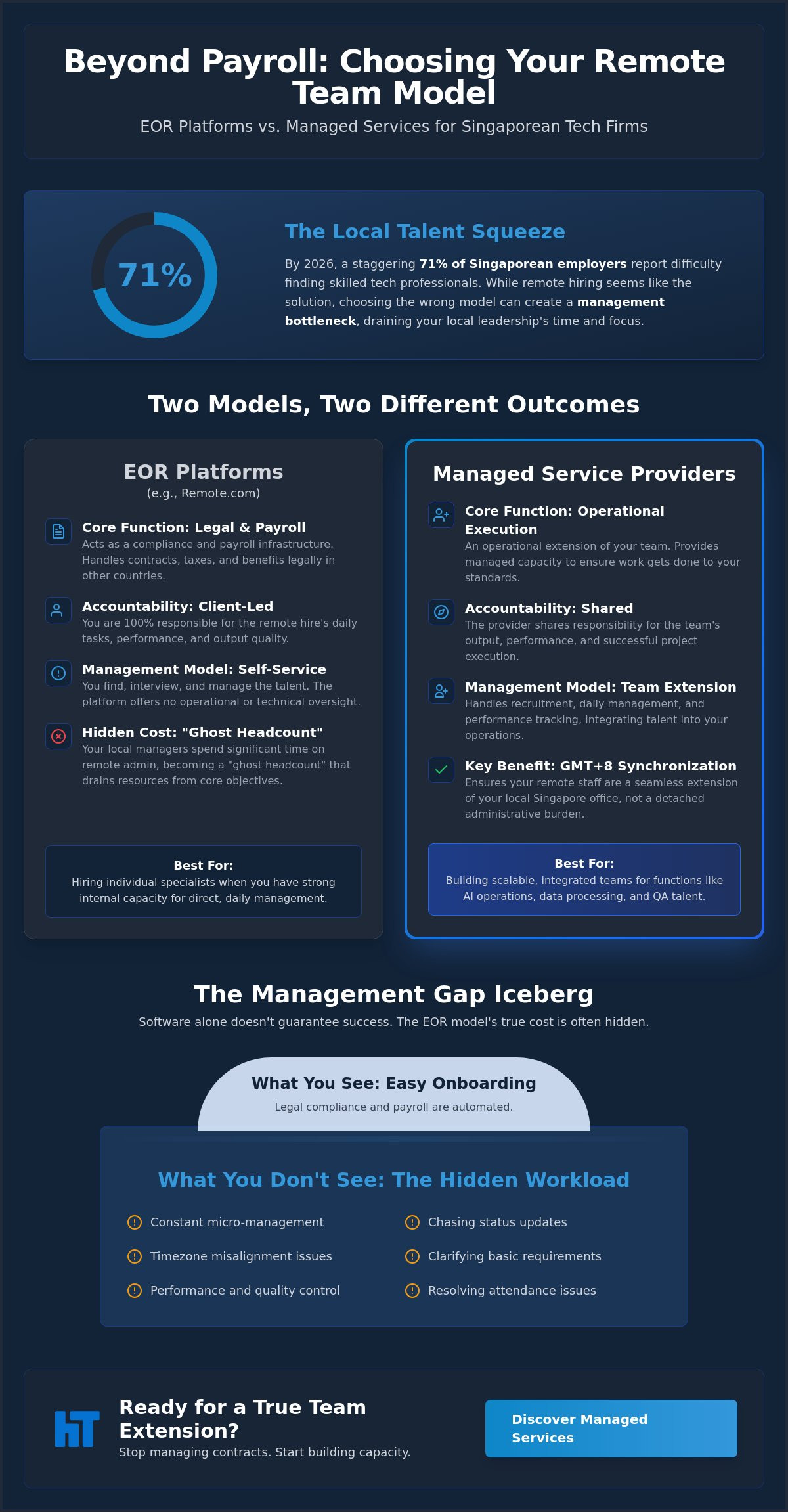
An Employer of Record (EOR) is a third-party organization that takes on the legal responsibilities of employment. This model is essentially a compliance and payroll infrastructure. In contrast, a managed service provider functions as an operational extension of your internal team. The core difference is accountability. In an EOR model, you're responsible for the employee's daily output and performance. In a managed service model, the provider shares the responsibility for ensuring the work actually gets done.
The Role of an EOR (e.g., Remote.com)
EOR platforms like Remote.com specialize in legal entity hosting and local compliance across more than 150 countries. They provide the software necessary to handle payroll, tax withholding, and mandatory benefits administration without requiring you to set up a foreign subsidiary. This is a self-service model. You find the talent, you interview them, and you manage their daily tasks. The platform simply ensures that the contract is legal and the salary is paid on time. It's a highly efficient tool for administrative logistics, but it offers no support for technical oversight or team integration.
The Role of a Managed Service Provider
A managed service provider offers active oversight and management of dedicated remote personnel. This model focuses on specific functional areas such as AI operations support, data processing, and Quality Assurance (QA) talent. Instead of just hosting a contract, the provider ensures the staff remains synchronized with your Singaporean operations. Recruitment is based on operational fit and technical proficiency rather than just geographic availability. By handling the daily management and performance tracking, the provider removes the micro-management load from your local managers. This creates a stable execution layer that functions reliably within the GMT+8 timezone, ensuring that remote staff aren't just "on the books" but are actively contributing to your technical objectives.
The Management Gap: Why Software Alone Does Not Ensure Operational Success
Hiring through a platform is often marketed as a complete solution, yet the reality of "self-service" remote hiring frequently reveals a significant management gap. While software can automate a contract, it cannot supervise a developer or ensure that a QA engineer is meeting your internal standards. When comparing remote.com vs managed services, the primary differentiator is who carries the burden of daily oversight. For many Singaporean firms, the time saved on administrative onboarding is quickly lost to the constant micro-management required to keep unmanaged offshore staff aligned with project goals.
The hidden cost of the EOR model lies in the redirection of your local leadership's focus. Instead of driving high-level strategy, your senior managers often become remote administrators. They find themselves chasing status updates, clarifying basic requirements, and resolving attendance issues. To truly optimize your contingent workforce, you must account for the hours spent on these non-core activities. A managed service provider addresses this by providing a dedicated management layer that absorbs these operational frictions before they reach your internal team.
Accountability and Performance Oversight
Accountability in a remote environment requires more than just a digital login. In an EOR setup, if a remote hire underperforms, the platform's role is limited to processing a termination or filing a support ticket. There is no middle management to course-correct in real time. Managed services introduce the "manager’s manager" concept. This professional facilitator monitors daily output, handles performance interventions, and ensures that staff remain productive. This structure protects your local team from the exhaustion of offshore oversight. If you require a team that operates with minimal internal friction, exploring managed operations often provides a more stable path than a platform-only approach.
Timezone Synchronization (GMT+8 Focus)
Singapore tech teams operate within a specific regional rhythm. When remote staff are unmanaged, technical feedback loops often suffer from 12-hour delays, which can stall a sprint for an entire day. Managed services prioritize geographic and temporal alignment to ensure your remote staff are active during your core operational hours. This synchronization eliminates the friction of misaligned schedules. It allows for immediate communication and rapid iteration, which are essential for high-velocity technical teams. By maintaining a strict GMT+8 focus, a managed service ensures that your offshore talent functions as a synchronous extension of your Singapore headquarters rather than a detached, asynchronous resource.
Financial and Compliance Frameworks: Comparing ROI and Risk
Evaluating remote.com vs managed services requires looking past the monthly invoice to understand the true impact on your bottom line. EOR platforms typically charge a flat per-head fee, which often appears cost-effective on a preliminary balance sheet. However, this figure ignores the "Ghost Headcount" cost. This phenomenon occurs when your internal Singaporean managers are forced to act as remote administrators, effectively increasing the true cost of every offshore hire through diverted senior-level salaries.
Direct Costs vs. Total Cost of Ownership (TCO)
Total Cost of Ownership represents the sum of all direct and indirect expenses associated with a remote hire, including platform subscriptions and the value of internal management hours diverted from core business goals. While an EOR platform might cost $599 per employee, the TCO rises sharply if your local technical lead spends five hours a week troubleshooting that hire's output or attendance. Managed services consolidate these costs into a comprehensive service fee that covers both the talent and the management layer. This structure allows your local team to reclaim their time, providing a higher ROI by focusing internal resources on high-impact product development rather than administrative oversight.
Scaling a team from one to ten specialized roles highlights the limitations of the self-service model. Adding ten individual contracts on an EOR platform creates ten separate management streams for your internal staff to handle. A managed service provider simplifies this by overseeing the entire functional unit, whether it involves AI operations support or a dedicated QA team. This model ensures that as your headcount grows, your internal management burden remains flat, providing a predictable path for expansion.
Data Processing and Security Compliance
Compliance involves more than just local payroll taxes; it requires strict adherence to data security and IP protection protocols. When managing contingent workers through a platform, the responsibility for enforcing security standards rests entirely on your shoulders. The platform hosts the contract, but it doesn't monitor the remote work environment or the handling of sensitive datasets.
Managed services mitigate this risk by implementing operational security protocols at the source. This is particularly critical for Singaporean firms handling sensitive data processing or ERP support, where remote environments must meet stringent security standards. By providing active oversight of daily activities, a managed partner ensures that your intellectual property remains secure. They enforce the use of secure hardware and encrypted connections, ensuring that your remote operations remain as compliant and secure as your local office in Singapore. To maintain this standard across your entire organization, Mytech Partners allows you to explore Managed IT Services for comprehensive cloud and productivity support.
Strategic Alignment: Matching the Model to Your Technical Requirements
Selecting between remote.com vs managed services requires a clear assessment of your project's technical complexity and scale. An EOR platform is often the logical choice when you need to hire a single high-level executive or a unique specialist who will report directly to your CTO. This model works well for isolated roles where the individual is already deeply experienced and requires minimal daily guidance. However, as you move toward scaling functional units, the self-managed nature of a platform can create operational friction that slows down your development pipeline.
Managed services are specifically designed for high-volume or repetitive tech functions that require consistent output. This model is superior for teams handling data-heavy workflows or ongoing maintenance tasks where quality must remain uniform across multiple contributors. With Singapore's technology spending projected to grow by 6% in 2026, firms are increasingly prioritizing models that provide a reliable operational backbone. If your goal is to build a scalable department rather than just filling a seat, a managed approach ensures that your technical requirements are met with disciplined execution and minimal internal overhead.
Specialized Talent: AI Ops and Data Processing
AI data training and high-volume data labeling require a level of quality oversight that standard EOR platforms aren't built to provide. Relying on task-based marketplaces or unmanaged contractors often leads to inconsistent data sets, which can compromise your model's accuracy. Managed teams provide dedicated personnel who are trained in your specific operational standards. This consistency is vital for AI operations where the consequence of poor data processing is a direct hit to product performance. By utilizing managed data processing services, you secure a team that understands the technical nuances of your project and delivers reliable results daily.
Quality Assurance and ERP Support
Integrating remote QA engineers into your GMT+8 sprint cycles requires more than just a shared Slack channel. It requires a synchronized management layer that ensures testing is completed before your Singaporean developers start their day. Managed services prevent the "knowledge silo" that often forms in remote technical support by documenting processes and maintaining a continuous feedback loop. This is particularly important for ERP support, where core business systems must remain operational without interruption. A managed partner handles the complexities of these technical roles, ensuring that your remote staff remains a functional and transparent part of your wider engineering team.
Integrating Managed Remote Talent into Your Singapore Operations
Transitioning from a self-managed platform to a functional team extension is the final step in resolving the remote.com vs managed services debate. While platforms provide the legal permission to hire, they don't provide the operational stability needed to scale a technical department effectively. In Singapore's competitive 2026 market, where 71% of employers struggle to find skilled talent, the focus must shift from administrative hosting to reliable execution. Havelock Tech operates as a disciplined facilitator, ensuring your remote staff functions as a seamless extension of your Singaporean headquarters.
We manage the GMT+8 operational rhythm to eliminate the friction typically associated with offshore teams. This synchronization ensures that your remote personnel are active and productive during your core business hours. By providing a managed layer of oversight, we reduce the administrative friction that often stalls technical projects. This allows your internal leadership to stop "managing remote" and start "scaling execution" with the quiet confidence of a partner who understands the mechanics of professional delivery.
The Havelock Tech Managed Model
Our model provides dedicated personnel for AI operations support, Quality Assurance (QA) talent, and ERP support. We handle the full administrative scope, including contracts, payroll, and local compliance, so you can remain focused on your primary objectives. Unlike a self-service platform, we provide ongoing management oversight to ensure that every team member remains aligned with your priorities. This "safe pair of hands" approach handles the back-end complexities, providing a low-risk, high-utility extension of your existing professional environment.
Next Steps for Your Tech Team
Evaluating your next move requires a pragmatic assessment of your current management bandwidth. If your technical leads spend significant time on offshore oversight, your current model may be hindering your growth. Determine which high-volume or repetitive tech functions are best suited for a managed remote pilot to begin reclaiming your team's time. You can consult with Havelock Tech on your remote scaling strategy to discover how a managed service can stabilize and synchronize your regional operations.
Optimizing Your Technical Execution Layer
Deciding between remote.com vs managed services is a choice about where you want your leadership's focus to lie. EOR platforms solve the legal complexity of international hiring, but they don't address the daily operational load of managing offshore staff. Managed services bridge this gap by providing both the administrative framework and the management oversight required for consistent technical output. This model ensures that your remote personnel remain synchronized with your GMT+8 operations, which protects your internal team from the exhaustion of constant micro-management.
Transitioning to a managed framework allows your Singaporean tech team to reclaim valuable time while maintaining strict quality control over AI and QA functions. This shift from simple administrative hosting to active execution management provides the stability needed for long-term growth. Scale your Singapore tech team with managed remote talent to build a reliable and integrated offshore capability. You can move forward with the assurance that your remote operations are in expert hands.
Frequently Asked Questions
Is Remote.com an EOR or a managed service provider?
Remote.com is primarily an Employer of Record (EOR) platform. It functions as a legal and administrative host that handles payroll, taxes, and local compliance across multiple countries. It doesn't provide daily management or technical oversight. When comparing remote.com vs managed services, remember that Remote.com provides the infrastructure for you to manage the employee, whereas a managed service provider handles both the employment and the daily output.
What are the main disadvantages of using an EOR platform for tech teams?
The primary disadvantage is the significant management burden placed on your local Singaporean team. Because EOR platforms are self-service, your internal managers must supervise every technical detail, from daily attendance to code quality. This often leads to management leakage, where senior staff spend hours on administrative oversight instead of high-level strategy. Without a managed layer, unmanaged remote hires can suffer from performance drift and cultural misalignment.
How does a managed service provider handle remote staff performance?
Managed service providers implement a structured oversight framework to monitor daily attendance and task completion. A dedicated facilitator acts as a manager's manager, ensuring that remote staff meet specific KPIs and quality standards. This proactive approach allows for immediate intervention if performance dips. It removes the stress of micro-management from your local team, providing a reliable execution layer that ensures technical objectives are met without constant internal supervision.
Can I use a managed service if I only need one remote QA engineer?
Yes, you can utilize managed services for individual specialized roles. While the model is highly effective for scaling entire teams, it's equally valuable for securing a single remote QA engineer or an AI operations specialist. This ensures that even a single hire benefits from professional management and GMT+8 synchronization. It's an ideal way to pilot a managed remote strategy without committing to a large headcount immediately.
Does Havelock Tech handle the legal compliance and payroll for remote staff?
Havelock Tech provides full administrative handling as part of our managed service. This includes managing contracts, payroll, and local compliance requirements for your remote team members. We function as the legal employer while simultaneously providing the operational management that a standard EOR lacks. This dual approach ensures that your team is both legally compliant and operationally productive, removing the back-end complexity from your Singaporean operations.
What is the benefit of GMT+8 timezone alignment for Singapore companies?
Timezone alignment ensures that your remote staff are active and available during your core operational hours in Singapore. This synchronization eliminates the 12-hour feedback delays that often stall technical projects in unmanaged remote setups. It allows for real-time communication, immediate problem-solving, and tighter integration into your local sprint cycles. By maintaining a GMT+8 rhythm, your remote talent functions as a synchronous extension of your office.
How do managed services protect my company IP and data?
Managed services enforce strict operational security protocols at the source. This includes monitoring the remote work environment and ensuring that sensitive data is handled according to Singaporean security standards. We supervise the use of secure hardware and encrypted connections to protect your intellectual property. This active oversight provides a level of data security that self-service platforms cannot offer, as they don't monitor daily employee activities or data handling practices.
Is it more expensive to use a managed service than an EOR like Remote.com?
While the direct service fee for a managed service may appear higher than a platform subscription, the Total Cost of Ownership (TCO) is often lower. When evaluating remote.com vs managed services, you must account for the cost of your internal managers' time. A managed service reclaims those hours, allowing your senior staff to focus on revenue-generating activities. This efficiency often results in a better long-term ROI by reducing the hidden costs of unmanaged remote administration.