

As software development cycles accelerate, the pressure on Quality Assurance (QA) to keep pace has never been greater. For many technology firms in Singapore, the traditional approach of relying solely on local, in-house manual testers has become a significant bottleneck, slowing down releases and increasing the risk of production bugs. The market for skilled QA automation engineers is highly competitive, making it difficult and expensive to scale teams locally.
The solution lies in a strategic shift: building and scaling a team of remote QA automation engineers. However, success requires more than simply finding a freelancer on a global platform. It demands a structured approach to integration, management, and timezone alignment to ensure the remote team functions as a seamless extension of your local development efforts. This guide provides an operational framework for Singaporean tech leaders to build a high-performing remote QA automation function that accelerates deployment frequency while enhancing software quality.
The Strategic Role of Remote QA Automation Engineers
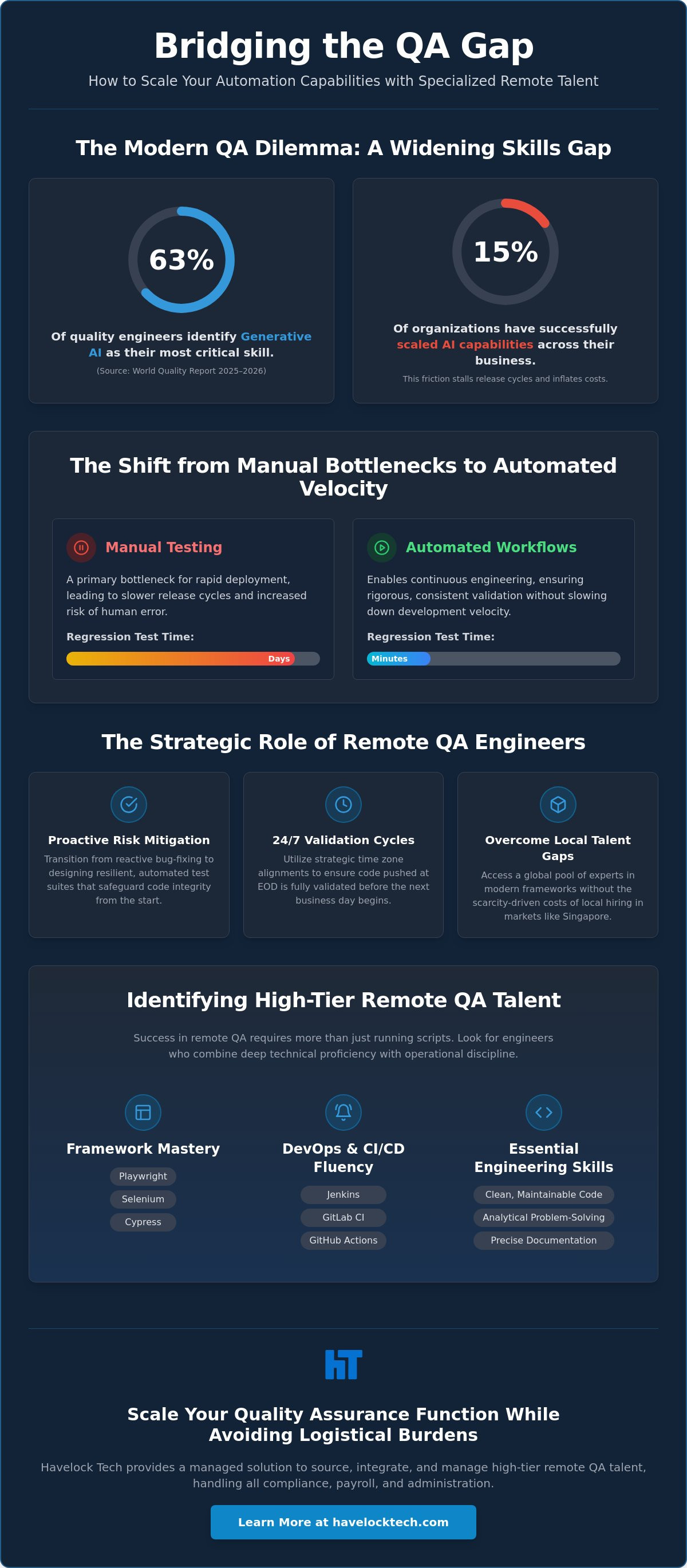
The role of a modern QA professional has evolved significantly. It is no longer about manually clicking through interfaces before a release. Today, it’s about building resilient, automated test suites that provide rapid feedback to developers, enabling a continuous integration and deployment (CI/CD) pipeline. Remote QA automation engineers are at the forefront of this transformation, offering specialized skills that are often in short supply locally.
- Defining the role: Beyond manual testing, these engineers design, code, and maintain automated tests that cover everything from UI interactions to complex API workflows, ensuring software resilience.
- Why Singaporean firms are pivoting: Faced with a tight local talent market and high salary expectations, Singaporean companies are turning to remote automation talent in 2026 to scale their QA capabilities cost-effectively.
- The impact of automated regression testing: By automating the repetitive and time-consuming task of regression testing, teams can deploy new features more frequently and with greater confidence, knowing that existing functionality has not been broken.
- A synchronized team extension: When managed correctly, remote talent synchronized to your timezone acts as a powerful extension of your local development efforts, participating in daily stand-ups and providing real-time feedback.
Addressing the Local Talent Gap in Singapore
The demand for skilled Software Development Engineers in Test (SDETs) in Singapore far outstrips the available local supply. This market dynamic creates a challenging hiring environment, forcing companies to compete for a limited pool of candidates, often at a premium cost. This is where a remote strategy becomes a powerful competitive advantage, allowing firms to tap into a global talent pool without the geographical constraints.
The modern standard for this role is the Software Development Engineer in Test (SDET), a hybrid professional who possesses both deep software development skills and a testing-focused mindset. By looking beyond local borders, companies can scale their teams with highly qualified engineers, achieving cost-efficiency without ever sacrificing technical standards. This approach allows you to build a robust QA function that supports, rather than hinders, your growth.
The Shift from Manual to Automated Workflows
In many organizations, the "bottleneck" phase in the release cycle is manual regression testing. This process is not only slow and prone to human error but also fundamentally incompatible with modern Agile and DevOps environments that rely on speed and iteration. Manual testing alone cannot provide the rapid feedback loop required to support multiple deployments per day or week.
Investing in automated test infrastructure delivers significant long-term ROI. While it requires an upfront investment in time and resources, the payoff comes in the form of accelerated release velocity, reduced bug leakage into production, and freeing up developers and manual testers to focus on more complex, exploratory testing. This shift from a manual to an automated workflow is essential for any technology company looking to scale effectively in 2026.
Identifying the Right Skills for Remote QA Success
Building a successful remote QA automation team starts with identifying candidates who possess the right blend of technical expertise and collaborative skills. The remote nature of the work places a premium on clear communication and the ability to work independently within a structured framework. Simply looking for keyword experience on a resume is insufficient; a deeper evaluation is required.
- Hard skills: Proficiency in modern automation frameworks like Selenium, Cypress, or Playwright is essential for building robust UI tests.
- Coding standards: Your QA automation engineers are developers. They must be able to write clean, maintainable, and scalable code in languages like Python or Java to ensure the test suite itself doesn't become a liability.
- DevOps literacy: A strong understanding of CI/CD pipelines is critical. Engineers should be comfortable integrating their automated tests into tools like Jenkins, GitLab, or GitHub Actions to enable continuous testing.
- Communication: The ability to document bugs with precision, provide clear reproduction steps, and collaborate asynchronously with developers via tools like Slack and Jira is non-negotiable for a remote team member.
Technical Proficiency Checklist
A thorough technical assessment is crucial to vetting remote candidates. This process should mimic real-world tasks to provide a clear picture of their capabilities. Start by evaluating their experience with API testing tools like Postman or libraries like RestAssured, as this is often where the most critical business logic resides. Contrast this with their UI testing skills to ensure they can provide full-stack coverage.
Furthermore, the importance of SQL knowledge cannot be overstated. Many automated tests require database verification to confirm that actions performed through the UI or API have resulted in the correct data state. Your technical assessment should include a practical exercise that requires the candidate to write queries to validate test outcomes. This ensures they can test the application end-to-end, from the user interface down to the data layer.
The Timezone Factor: Why GMT+8 Alignment Matters
For Singaporean companies, timezone alignment is not a luxury; it is an operational necessity. Attempting to collaborate with a team operating on a 12-hour time difference introduces significant friction, especially when dealing with urgent bug fixes. A critical production issue discovered at the start of your business day may not even be seen by the remote team until you are signing off, leading to costly delays.
The advantages of same-timezone collaboration are immense. It allows remote QA engineers to participate in key Agile ceremonies like Sprint planning and daily stand-ups, fostering a sense of shared purpose and ensuring everyone is aligned on priorities. At Havelock Tech, we ensure all our remote talent is fully synchronized with Singapore business hours (GMT+8), eliminating communication delays and enabling the real-time collaboration required for high-velocity development.
How to Integrate Remote QA Engineers into Your Workflow
Successfully integrating remote team members requires a deliberate and structured onboarding process. You cannot simply provide a laptop and a login; you must create a remote-first environment where they have the access, context, and communication channels needed to be effective from day one. This proactive approach minimizes ramp-up time and sets the stage for a productive long-term partnership.
- Step 1: Audit your current testing documentation and environment access. Before your new team member starts, ensure that test plans, environment details, and access credentials are well-documented and readily available.
- Step 2: Establish clear communication channels and meeting cadences. Set up dedicated Slack or Teams channels and schedule regular check-ins, stand-ups, and planning sessions to foster constant communication.
- Step 3: Integrate remote engineers into your Jira or Azure DevOps ticketing systems. Provide full access to your project management tools so they can be assigned bugs, track their work on test automation tasks, and participate in the development lifecycle.
- Step 4: Define a clear "Definition of Done" (DoD) for automated test scripts. This should include requirements for code reviews, documentation, and successful integration into the CI/CD pipeline, ensuring quality and consistency across all automated tests.
Establishing the Remote-First Infrastructure
A robust infrastructure is the foundation of a successful remote team. The primary concern is providing secure access to your development and testing environments. This is typically achieved by setting up secure VPN or Virtual Desktop Infrastructure (VDI) access for all remote personnel, ensuring that your company's intellectual property remains protected.
Consistency is also key. It is crucial to standardize the technology stack across both local and remote team members to avoid fragmentation and ensure everyone is working with the same tools and frameworks. Critically, a unified documentation repository, such as a Confluence or Notion workspace, is necessary to serve as a single source of truth for processes, test cases, and architectural information for the entire distributed team.
Defining Reporting and Accountability
Managing a remote team requires a shift from measuring presence to measuring output. Establish a clear reporting structure—whether it's a brief daily summary of progress or a more detailed weekly report—to maintain visibility into automation efforts. The goal is not micromanagement but alignment and early identification of blockers.
Success for a remote QA engineer should be measured by tangible outcomes, not just activity. Instead of focusing on bug count, which can incentivize finding trivial issues, focus on metrics like the growth of automated test coverage for critical user journeys and a reduction in escaped defects (bugs found in production). Utilizing automated dashboards that pull data from your test execution and CI/CD tools can provide a real-time, objective view of your application's QA health, making performance management transparent and data-driven.
Overcoming Common Challenges in Remote QA Management
While the benefits of a remote QA team are significant, tech leaders must be prepared to navigate a unique set of challenges. These operational hurdles extend beyond technology and into the realms of culture, administration, and security. Proactively addressing these issues is the difference between a high-performing team extension and a source of constant friction.
- Managing cultural nuances: Ensuring alignment with Singaporean business etiquette and your company's specific communication style is vital for smooth collaboration.
- The "Administrative Burden": Handling international payroll, local employment law compliance, and hardware logistics for an offshore workforce can quickly become a major distraction for your core business.
- Maintaining security and IP protection: Robust security protocols and clear contractual agreements are necessary to protect your intellectual property when working with an offshore team.
- Preventing "Siloing": It is essential to make a conscious effort to ensure remote QA engineers feel like an integral part of the core engineering team, not an isolated, external unit.
Navigating Administrative and Compliance Complexity
The risks associated with direct offshore hiring are often underestimated. Each country has its own complex web of legal, tax, and employment laws that a Singaporean company may not be equipped to navigate. An error in compliance can lead to significant legal and financial penalties. Furthermore, managing international payroll, with its varying currencies and regulations, can place a heavy burden on your HR and finance teams, distracting them from their primary responsibilities.
This is where a managed service provider becomes invaluable. A partner like Havelock Tech absorbs these logistical headaches entirely. We handle all contracts, payroll, and local compliance for the remote staff, insulating you from the complexity and risk. This model allows you to gain the benefits of global talent without the administrative overhead. While this strategic checklist is for data specialists, the principles of vetting a managed partner for compliance and administrative support apply directly to building a remote QA team.
Ensuring High Performance and Retention
High performance in a remote setting does not happen by accident; it requires structure and oversight. The importance of ongoing management from a partner who understands the remote work dynamic cannot be overstated. This includes regular performance reviews, one-on-one meetings, and feedback loops designed specifically for a remote-first environment.
Retention is equally critical. Top-tier remote QA automation engineers, like their local counterparts, are motivated by professional growth. Providing a clear career path, opportunities for learning new technologies, and a sense of stability are key to retaining your best talent. A managed service provider invests in its people, ensuring they remain engaged and motivated, which translates to higher quality work and lower turnover for your team.
The Managed Solution: Scaling with Havelock Tech
For Singaporean tech companies looking to scale their QA automation capabilities without the associated operational drag, a managed service model offers the ideal solution. It combines the talent access of a global marketplace with the stability, security, and oversight of an in-house team. Havelock Tech provides dedicated, pre-vetted QA automation engineers who become a full-time part of your team, but without the hiring and administrative overhead.
- Dedicated QA talent without the hiring overhead: We handle the entire recruitment, vetting, and hiring process, presenting you with top-tier candidates who match your technical and cultural requirements.
- The "Safe Pair of Hands": Our managed model provides a layer of professional oversight and accountability that is absent in the freelance marketplace, mitigating risk and ensuring quality.
- Seamless integration: All our remote personnel work exclusively for you and are fully synchronized with the Singaporean (GMT+8) timezone, ensuring they operate as a true extension of your local team.
- Focus on execution: We manage all the administration—from payroll and compliance to HR support—allowing you to focus entirely on defining priorities and directing the work of your QA team.
Why a Managed Service Fee Model is Superior
The financial and operational structure of a managed service offers distinct advantages over hiring freelancers or direct offshore employees. A predictable monthly fee per team member allows for clear budget forecasting, eliminating the fluctuating and often-unpredictable costs associated with project-based freelance work. This model transforms your QA function from a variable expense into a stable operational investment.
Crucially, this approach eliminates the painful and time-consuming recruitment cycle you would face every time you need to scale. Instead of starting a search from scratch, you can simply request additional capacity from your managed service partner. The value of having a local Singaporean partner managing your offshore team provides a single point of contact and accountability, bridging any cultural or communication gaps and ensuring your standards are always met.
Getting Started: Your QA Team Extension
The process of extending your team with Havelock Tech is designed to be efficient and transparent. It begins with a deep-dive consultation to understand your specific technical needs, project goals, and team culture. We then leverage our recruitment expertise to identify and rigorously vet top-tier remote QA automation engineers from a global talent pool, assessing not only their technical skills but also their communication and problem-solving abilities.
Once you select your ideal candidate, we manage the entire onboarding process, from contract and compliance to hardware and system access. Your new team member arrives ready to contribute, often writing their first automated test script within the first week. This seamless integration process allows you to increase your testing capacity and accelerate your release cycles almost immediately.
Ready to increase your testing capacity? Contact Havelock Tech to build your managed remote QA team today.
Frequently Asked Questions (FAQs)
What is the difference between a manual tester and a QA automation engineer?
A manual tester executes test cases by hand, interacting with an application as a user would to find defects. A QA automation engineer, or SDET, is a developer who writes code to automate these tests. Their goal is to build a repeatable, scalable, and fast test suite that can be run automatically as part of the CI/CD pipeline, providing rapid feedback to the development team.
Can remote QA automation engineers work in the Singapore timezone (GMT+8)?
Yes, absolutely. This is a critical requirement for effective collaboration. Reputable managed service providers like Havelock Tech specialize in sourcing and managing talent that is committed to working full-time during Singapore business hours (GMT+8), ensuring seamless integration with your local team for meetings, stand-ups, and real-time problem-solving.
How do I ensure my data is secure when working with remote QA staff?
Security is paramount. It is best practice to use a multi-layered approach: secure access via VPN or VDI, strict NDAs and contractual agreements, and providing access only to sandboxed testing environments with anonymized or synthetic data whenever possible. A managed service provider adds another layer of security by handling compliance and ensuring all personnel operate under strict professional protocols.
What automation tools are most common for remote engineers in 2026?
In 2026, proficiency in a range of tools is expected. For web UI automation, frameworks like Cypress, Playwright, and Selenium remain dominant. For API testing, Postman and libraries like RestAssured (for Java) or Pytest (for Python) are standard. A strong understanding of CI/CD tools like Jenkins, GitLab CI, or GitHub Actions is also essential for integrating tests into the development pipeline.
Is it better to hire a freelance QA engineer or use a managed service?
For short-term, non-critical tasks, a freelancer can be a viable option. However, for building a long-term, scalable QA function, a managed service is superior. It provides dedicated, full-time engineers, professional oversight, administrative support (payroll, compliance), and greater stability, mitigating the risks of freelancer unreliability and turnover.
How long does it typically take to onboard a remote QA automation engineer?
With a managed service, the process is significantly accelerated. After you select a candidate, they can often be fully onboarded and integrated into your systems within 1-2 weeks. This includes setting up secure access, integrating them into your communication channels (Slack/Teams) and project management tools (Jira), and familiarizing them with your codebase and testing requirements.
What are the cost benefits of hiring remote QA engineers for Singapore companies?
The primary cost benefit is access to a global talent pool at more competitive salary points than the overheated local Singapore market. Additionally, a managed remote model eliminates overhead costs associated with office space, hardware, and local employer contributions (like CPF). This allows you to build a larger, more capable team for the same budget.
How do I manage the performance of someone I cannot see in the office?
Performance management for remote staff should be outcome-based, not presence-based. You manage their performance by setting clear expectations and measurable goals (e.g., increase test coverage by X%, reduce release-blocking bugs by Y%). Regular check-ins, code reviews, and transparent dashboards that track the progress of the automation suite provide the data needed to effectively manage performance.