

The Pragmatic Guide to Outsourcing AI Data Training in 2026
As AI models become more sophisticated, the bottleneck for development is shifting from complex algorithms to the quality and volume of training data. For technology leads and operations managers in Singapore, the challenge is acute: the high cost of local talent makes scaling in-house data teams unsustainable, yet generic outsourcing often leads to poor quality and communication friction. The key to successful scaling lies not in finding the cheapest labour, but in building a reliable, well-managed data supply chain.
This guide provides a pragmatic framework for outsourcing AI data training. We will explore how to choose the right outsourcing model, implement robust quality assurance, and eliminate the operational drag caused by timezone misalignment. The goal is to move beyond the simple delegation of tasks and toward the strategic integration of managed remote talent, enabling you to scale AI operations predictably and efficiently.
Why Outsourcing AI Data Training is Essential for Scaling Models
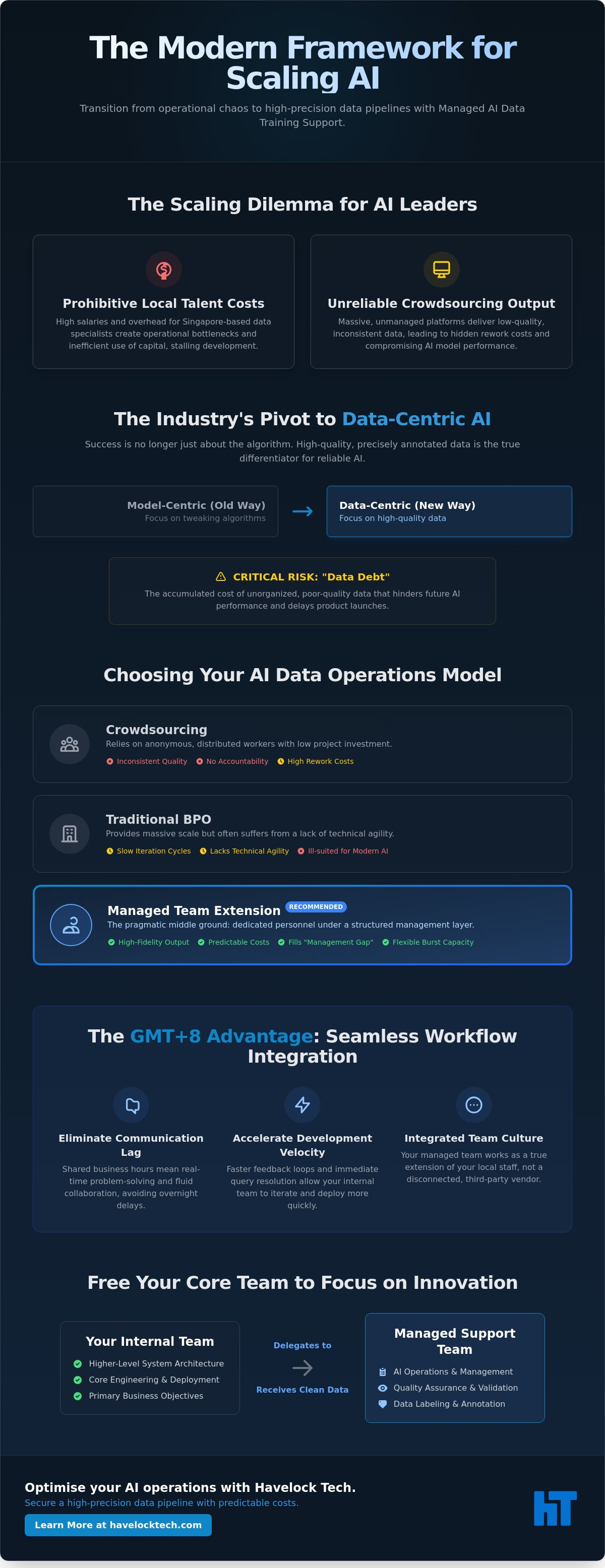
Outsourcing AI data training involves delegating the critical but repetitive tasks of data labeling, annotation, cleaning, and validation to an external, specialised team. As the industry pivots from a "model-centric" to a "data-centric" approach, the strategic importance of this function has grown exponentially. Success no longer depends solely on the sophistication of the algorithm but on the quality of the data that fuels it.
This shift highlights a critical operational challenge known as "Data Debt"—the accumulated cost of unorganised, poorly labelled, or inconsistent data that hinders future AI performance. Just as financial debt accrues interest, data debt creates compounding problems that can halt model development and erode the accuracy of production systems. For many organisations, attempting to manage this high-volume, detail-oriented work with expensive, locally-hired engineers is operationally and financially unsustainable. It diverts core talent from high-value architectural work to repetitive data processing tasks.
The Rise of Data-Centric AI
The principle of data-centric AI posits that for most practical applications, the quality and quantity of the training dataset have a greater impact on model performance than minor tweaks to the algorithm. This is especially true for complex systems requiring a high degree of nuance, such as generative AI and Large Language Models (LLMs). Refining these models depends heavily on Human-in-the-loop (HITL) processes, where human intelligence is used to correct, validate, and improve machine-generated outputs. Scaling this human feedback loop is a significant operational hurdle that managed outsourcing is uniquely positioned to solve.
Economic and Operational Drivers
For Singapore-based companies, the economic drivers for outsourcing are compelling. The cost of hiring a local data scientist or machine learning engineer is substantial, and assigning them to tasks like data labelling represents a significant misallocation of resources. A managed remote support specialist can perform these essential functions at a fraction of the cost, freeing your core technical team to focus on model architecture, research, and deployment.
Furthermore, AI development is not linear. It often requires "burst capacity"—a sudden, temporary increase in data processing resources—during large-scale model retraining cycles. Building a full-time local team to handle these peaks is inefficient. A managed outsourcing partner provides the flexibility to scale your data operations team up or down in response to project demands, converting a fixed headcount cost into a predictable, variable operational expense.
Evaluating Different Outsourcing Models for AI Data Preparation
Choosing the right outsourcing model is critical to achieving the desired balance of cost, quality, and control. The landscape is dominated by three primary approaches: Crowdsourcing, traditional Business Process Outsourcing (BPO), and Managed Team Extension. Each has distinct advantages and disadvantages, but for technology-heavy firms requiring high-quality, context-aware data, the differences are stark.
A common pitfall in traditional outsourcing is the "Management Gap," where the client company saves on labour costs but inherits the significant administrative burden of recruiting, training, and managing a disparate group of remote individuals. This overhead can negate the intended efficiency gains. The most effective models are those that provide a layer of professional oversight, turning a collection of freelancers into a cohesive, accountable team.
Crowdsourcing vs. Dedicated Managed Teams
Crowdsourcing platforms offer access to a vast, on-demand workforce for simple, discrete tasks. While effective for massive-scale, low-complexity jobs, this model breaks down when applied to nuanced AI data training.
Here’s a direct comparison:
| Feature | Crowdsourcing | Managed Team Extension |
|---|---|---|
| Worker Accountability | Anonymous workers with little long-term accountability. High churn. | Vetted, dedicated personnel who are part of a stable team. |
| Contextual Learning | Each task is new to the worker. No accumulated project-specific knowledge. | Team develops deep contextual intelligence about your specific industry and data nuances over time. |
| Data Security | High risk; data is exposed to a large, unvetted, and anonymous crowd. | Low risk; personnel are vetted and operate within secure, controlled environments (e.g., VDI). |
| Task Complexity | Best for simple, binary tasks (e.g., "Is this a cat?"). | Ideal for complex, multi-step tasks requiring judgment (e.g., medical imaging, legal document analysis). |
| Management Overhead | Requires extensive quality control, consensus mechanisms, and rework management by the client. | Management of personnel, payroll, and HR is handled by the service provider. |
For AI applications in specialised fields like finance, healthcare, or law, the lack of contextual learning in crowdsourcing is a critical failure point. A dedicated managed team, by contrast, becomes an extension of your own, accumulating valuable domain knowledge that directly improves data quality and consistency.
Managed Services: The "Manager’s Manager" Approach
The Managed Team Extension model offers a pragmatic middle ground for technology companies that need control over quality without the administrative friction of direct hiring. In this model, a provider like Havelock Tech handles the recruitment, vetting, payroll, local compliance, and day-to-day oversight of the remote personnel. The client retains complete control over task priorities, workflows, and quality standards.
This "manager's manager" approach is particularly beneficial for Singaporean HR and operations departments. It eliminates the complexities of cross-border employment and allows your internal leaders to focus on strategic outcomes rather than administrative details. You get the benefits of a dedicated, expert team without the liabilities and overhead of expanding your direct headcount.
Solving the Quality-Speed Paradox in AI Data Operations
The most common objection to outsourcing is the fear that data quality will decline. This concern stems from the "Quality-Speed Paradox": the belief that increasing the speed and volume of data processing will inevitably lead to a drop in accuracy. However, this paradox is not a law of nature; it is a symptom of poor management and misaligned processes. It can be solved through a structured approach that combines clear documentation, robust quality assurance, and tight feedback loops.
Success requires fostering "Contextual Intelligence" within the remote team. This is the deep, nuanced understanding of your project’s specific requirements, edge cases, and objectives that can only be built over time. A stable, dedicated team is essential for developing this intelligence, which is impossible to achieve with a transient, anonymous crowd.
Implementing Robust Quality Assurance (QA)
A systematic QA framework is the cornerstone of high-quality data operations. This is not about simply checking work after it's done; it's about building quality into the process from the start. Effective QA includes several key components:
- Gold Sets: A curated collection of data points with pre-established "correct" labels. These are used to test and calibrate the understanding of the data labellers on an ongoing basis.
- Consensus-Based Labeling: Assigning the same task to multiple annotators and using a consensus score to validate the result. Disagreements are flagged for review by a senior team member or the client.
- Regular Calibration Meetings: Scheduled syncs between your core AI team and the remote support team to review difficult edge cases, clarify instructions, and prevent "label drift"—the gradual, unintentional deviation from the original annotation guidelines.
Ultimately, data quality is a function of clear documentation and consistent feedback, not just individual worker skill. A managed service provider ensures these processes are implemented and rigorously maintained.
Data Security and Compliance in Remote Work
For companies handling sensitive information, security is a non-negotiable requirement. Outsourcing does not have to mean compromising on security. A professional managed services provider mitigates risk through a combination of technology and process:
- Secure Infrastructure: Remote teams work within controlled environments, often using Virtual Desktop Infrastructure (VDI) or secure VPN tunnels. This ensures that your proprietary data never resides on local machines.
- Vetted Personnel: Unlike anonymous crowd workers, managed remote professionals undergo background checks and are bound by formal employment contracts that include strict confidentiality and data protection clauses.
- Compliance with Local Standards: For Singaporean clients, it is crucial that the outsourcing partner understands and can adhere to regulations like the Personal Data Protection Act (PDPA), even when operating offshore. This includes implementing appropriate data handling protocols and ensuring all personnel are trained on their compliance obligations.
Building a Seamless Workflow with GMT+8 Remote Teams
In the fast-paced world of AI development, speed is a competitive advantage. One of the most underestimated barriers to high-velocity development is "timezone friction." When your core team in Singapore is ending their day just as your offshore team in London (GMT+0) or New York (GMT-5) is starting theirs, a simple question can lead to a 24-hour delay. This communication lag creates a cascade of inefficiencies that slows down iteration cycles and frustrates development teams.
Timezone alignment is the secret sauce of effective team extension. By engaging a managed team that operates in the same GMT+8 timezone, you eliminate this fundamental source of friction. Same-day communication becomes the default, enabling real-time collaboration and dramatically accelerating the feedback loop for training datasets.
The Advantage of Same-Timezone Collaboration
Working with a team in the same timezone transforms the dynamic from a transactional, ticket-based relationship to a truly collaborative partnership. The benefits are both practical and psychological:
- Elimination of the "24-Hour Delay": Clarifications on labelling instructions or edge cases can be resolved within minutes or hours, not days.
- Real-Time Troubleshooting: When issues arise in the data pipeline, your internal engineers and the remote support team can troubleshoot together in real-time.
- Integrated Team Culture: A remote team that starts and ends the day with you feels like a genuine extension of your local team. They can participate in daily stand-ups and become fully integrated into your company's rhythm.
Integrating Remote Talent into Agile Workflows
The goal of the Managed Team Extension model is to embed remote talent so seamlessly into your operations that they function as an internal department. This requires deliberate integration into your existing tools and processes.
- Tool Integration: Provide the managed remote staff with access to your primary communication and project management platforms, such as Slack and Jira. This ensures transparency and keeps all project-related communication in a central, accessible location.
- Clear KPIs: Establish and track clear Key Performance Indicators (KPIs) for the AI operations support team. These should focus on metrics that matter, such as data throughput, accuracy rates, and turnaround times.
- Agile Scaling: A key advantage of the managed service model is its flexibility. Work with your provider to define a process for scaling the team up or down based on the requirements of your current development sprints, allowing you to match resources precisely to your workload.
Optimising AI Operations with Havelock Tech Managed Talent
For Singaporean technology companies looking to scale their AI initiatives, Havelock Tech provides a pragmatic and operationally sound solution. We specialise in providing dedicated, managed remote personnel for AI Operations, Data Processing, and Quality Assurance, all operating seamlessly within the GMT+8 timezone.
Our model is designed to eliminate administrative friction while maximising your control and efficiency. Havelock Tech manages the entire back-end of talent acquisition and management—including recruitment, payroll, compliance, and HR—while you retain direct control over your team's priorities and quality standards. This allows you to focus on building world-class AI models, secure in the knowledge that your data pipeline is supported by a reliable, professional team.
The benefits of our approach are clear: perfect GMT+8 alignment for real-time collaboration, significantly reduced hiring and administrative overhead, and the reliable execution that comes from a dedicated, expertly managed team. For a deeper look into structuring these teams, our guide on AI Operations Support Services provides a comprehensive framework.
Tailored Remote Personnel for AI Teams
We understand that AI data training is not a generic task. Havelock Tech sources and vets specialists who possess the technical aptitude and attention to detail required for high-stakes data work. Our rigorous vetting process ensures that every team member is ready to integrate quickly into tech-heavy environments and contribute from day one. We provide the "safe pair of hands" needed to manage offshore payroll, HR, and compliance, mitigating the risks associated with international hiring and allowing you to scale with confidence.
Getting Started: From Requirement to Integration
Onboarding with Havelock Tech is a straightforward and transparent process. We begin with a thorough consultation to understand your specific data processing needs, quality benchmarks, and workflow requirements. From there, we assemble and present a dedicated team for your approval. Because our service is structured with predictable monthly fees instead of the fixed costs of direct headcount, you can scale your AI operations without the long-term financial risk. This flexible model allows you to build the data processing capacity you need, exactly when you need it.
Scale your AI operations with managed remote talent from Havelock Tech.
Frequently Asked Questions (FAQs)
- What is the difference between data labeling and AI data training support?
- Data labeling is the specific task of annotating raw data (e.g., identifying objects in images). AI data training support is a broader term that encompasses the entire data preparation lifecycle, including data labeling, cleaning, validation, quality assurance, and ongoing management of the data pipeline and the teams performing these tasks.
- How does Havelock Tech ensure the security of our sensitive training data?
- We implement multi-layered security protocols. Our personnel are thoroughly vetted and operate under strict NDAs. Operationally, we use secure infrastructure like Virtual Desktop Environments (VDI) to ensure your data is never stored on local devices. We work with you to adhere to your specific security and compliance standards, including Singapore's PDPA.
- Can managed remote teams handle complex data types like LiDAR or medical imaging?
- Yes. This is a key advantage of the managed team model over crowdsourcing. We build dedicated teams that receive specialised training on your specific domain and data types. This allows them to develop the contextual expertise required to accurately annotate complex, high-stakes data like medical scans or 3D point clouds from LiDAR sensors.
- Why is GMT+8 timezone alignment important for my AI project?
- GMT+8 alignment eliminates communication delays. It enables your Singapore-based team to collaborate in real-time with the remote support team, speeding up feedback loops, troubleshooting, and the overall iteration cycle of your AI models. A simple question can be answered in minutes, not the next day.
- Is it cheaper to use a managed service or hire directly via a platform like Upwork?
- While the hourly rate on a freelance platform might appear lower, the total cost of ownership is often much higher. When you hire directly, you bear the full burden of recruitment, training, quality control, and administrative management. A managed service bundles these costs into a predictable monthly fee, reducing your internal management overhead and delivering a more reliable, higher-quality outcome.
- How long does it take to onboard a dedicated remote AI support specialist?
- The timeline can vary based on the specific skill requirements, but our streamlined process is designed for efficiency. Typically, we can source, vet, and onboard new team members within a few weeks, significantly faster than the months it can take to hire for a full-time local position.
- Do I need to manage the remote team’s payroll and local taxes?
- No. Havelock Tech handles all administrative responsibilities, including payroll, local taxes, benefits, and compliance with local labour laws in the remote location. This is a core part of our managed service, designed to free you from all back-end administrative burdens.
- What happens if the quality of the data labeling doesn’t meet our standards?
- Because we provide a managed service, quality is a shared responsibility. We work with you to establish clear quality benchmarks and KPIs from the outset. Our management layer provides continuous oversight and performance management. If standards are not being met, we take immediate corrective action, including retraining or replacing personnel as needed, at no additional cost to you.